Guide to Options Sweeps

Guide to Options Sweeps


Editor's Note: Options are not suitable for all investors. Options involve risks, including substantial risk of loss and the possibility an investor may lose the entire amount invested in a short period of time. Please see the Characteristics and Risks of Standardized Options.

An options sweep is a large trade split into smaller orders and executed rapidly across multiple exchanges. These trades are typically placed by institutional investors to capitalize on perceived price movements in the markets.

While retail investors rarely place sweep orders themselves, watching for this type of unusual options activity may offer clues about institutional sentiment. Sweeps prioritize speed over price, and are seen as more aggressive trades that have high urgency.

Key Points

•   Executing a sweep order involves breaking a large options trade into smaller pieces across multiple exchanges.

•   Institutional investors often use sweeps to act quickly and take advantage of perceived market momentum.

•   Unusual options activity, including sweeps, may offer insight into short-term sentiment around a stock.

•   Interpreting a sweep trade requires context, including whether the trade executed near the bid or ask price.

•   Accessing sweep data typically requires a trading platform with real-time options flow or scanner tools.

What Are Options Sweeps?

Options sweeps are large options trades broken into smaller orders and executed by well-capitalized, typically institutional investors, across multiple exchanges at the best available order prices. The executing broker routes the order across multiple exchanges, filling it in the order of best available prices until the target trade size is met. (Note that SoFi does not execute options sweeps for traders at this time.)

The typical retail investor will not execute options sweep trades, given the large amount of funding and leverage they require. Instead, these options trades can serve as an indicator of underlying interest around a certain security. As they typically reflect institutional investor activity, sweep trades may reflect directional interest in a given stock.

What an options sweep implies is up to interpretation and depends on the order size, type of option, and average price at which the options sweep was executed. Understanding how options sweeps work may help retail investors interpret market activity.

How Do Options Sweeps Work?

When options sweeps are executed, the trade may be visible to market participants. The details around the trade, namely its size, the type of option traded, and the approximate price of the trade, are viewable by traders with the capability to scan for them. However, the specific entity entering the trade and the order type (whether it’s a buy or sell) will not be disclosed.

Option sweeps aren’t really considered one of the strategies for trading options. But given the massive amount of capital needed to properly transact an options sweep, and the fact that these are typically entered as block trades, entities that use option sweeps are likely to be well-capitalized institutional investors.

Consequently, options sweeps are sometimes viewed as indicators of aggressive trades that reflect conviction. This can stir up investor interest due to the perceived informational edge that institutional managers may have over retail investors, who may just be learning to trade options.

Under the right circumstances, they can provide useful insight into implied short-term price swings that large institutional investors might be hedging against. This can make them a popular tool for short-term traders.

How to Interpret Options Sweeps

Options sweeps serve as indicators of unusual options activity surrounding the underlying investment.

Options trades may imply aggressive actions by institutional investors, and traders who detect options sweeps may use them to inform their actions.

How an options sweep should be interpreted depends on the type of option being traded, its expiration date (American- and European-style options are different), and the price near where the options sweep was executed.

Regardless of what an options sweep may suggest, investors should bear in mind that institutional investors are fallible. In other words, sometimes the “smart money” isn’t so smart. Despite the perceived informational asymmetry, option sweeps should be interpreted cautiously. Investors should conduct independent research and review multiple indicators before acting on options sweep activity.

Option Type

When a trader buys to open a call option, this generally implies a bullish bet on the price of a security, as call options offer upside potential beyond the stated strike price.

Conversely, when a trader buys to open a put option, this implies a bearish bet on the direction of the underlying security, as put options offer downside protection beyond the stated strike price.

Price

While it’s evident that a trade was made when an options sweep occurs, the trade won’t explicitly disclose whether the options were bought or sold by the institutional investor.

To gauge whether or not an options sweep was a buy or sell order, and to better understand options pricing, traders can contextualize based on whether the average execution price was traded “near the bid,” or “near the ask.”

Trades made near the bid are typically sell orders, while trades near the ask are typically buy orders. This follows the traditional trading logic of “sell at the bid” and “buy at the ask.”

Combination Trades

Not all option trades are simply buy calls or buy puts. Combination trade strategies using multiple options are very common. It might be very difficult to interpret the strategy of the option sweep investor, and even more difficult to determine if your own investing strategy aligns.

Finally, user-friendly options trading is here.*

Trade options with SoFi Invest on an easy-to-use, intuitively designed online platform.

How to Detect Options Sweeps

Options sweeps are difficult to detect without the aid of dedicated trade scanners that monitor options flow activity.

Some third-parties and brokerage accounts that offer advanced trading capabilities may include this as part of a subscription fee, or as a part of their trading suite. (This service is not provided by SoFi currently.)

If you don’t have access to these paid programs, there are still ways to detect unusual options activity on stocks you follow.

First, options are useful hedging tools for institutional investors and are therefore often used during times of heightened market volatility.

You can watch for open options interest on calls and puts, expiring close to earnings reports or dividend announcements. Beyond company-specific announcements, traders can often gauge options interest close to market-moving events, economic reports, or even Federal Reserve statements.

While this won’t necessarily inform the direction of an upcoming trade, it could certainly shed some light on where trading volatility is likely to occur as the expiration date on the options approach.

Who Uses Options Sweeps

Options sweeps are used almost exclusively by large well-capitalized institutional traders.

Due to the large amount of capital needed to execute an options sweep, and the massive risk profile that this entails, it’s unlikely that anyone without a substantially large bankroll would be able to conduct an options sweep trade.

The complexity of these trades means retail investors are typically not able to execute options sweeps.

The Takeaway

While options sweeps are not usually executable by everyday investors, their existence still serves as a useful indicator of institutional activity.

Unusual options activity has historically been a popular short-term metric for gauging the direction of stocks. Although options sweeps don’t guarantee price moves, they may offer insight into short-term sentiment and serve as one of several tools used by options traders.

SoFi’s options trading platform offers qualified investors the flexibility to pursue income generation, manage risk, and use advanced trading strategies. Investors may buy put and call options or sell covered calls and cash-secured puts to speculate on the price movements of stocks, all through a simple, intuitive interface.

With SoFi Invest® online options trading, there are no contract fees and no commissions. Plus, SoFi offers educational support — including in-app coaching resources, real-time pricing, and other tools to help you make informed decisions, based on your tolerance for risk.

Explore SoFi’s user-friendly options trading platform.

🛈 SoFi does not execute options sweeps for traders at this time.

FAQ

Are call sweeps considered bullish?

Call option sweeps are large purchases or sales of call options that can be considered either bullish or bearish, depending on the price where the trade completes.

All options trades have both a bid and an ask price; the bid price indicates the price you’d receive for selling to open the option while the ask price indicates the price you’d pay to buy to open the option.

If a call sweep is shown executing near the bid price, it may suggest that an institutional trader sold a large number of call options at the bid price, which could imply a bearish signal.

Conversely, if a call sweep is shown executing near the ask price, that indicates that an institutional trader likely purchased a large number of call options at the ask price, which could imply a bullish signal.

How can you find options sweeps?

Finding options sweeps isn’t as simple as searching for individual trades. Detecting option sweeps requires scanning software that can sleuth through public trade data for unusual options activity.

There are a number of options activity scanners available online or through third-party information services; in most cases, these require paid subscriptions.

Many popular online brokerage accounts also offer activity scanners as part of their advanced trading platforms.

What does it mean for a sweep to be near the ask?

If a sweep is near the ask, it generally indicates that a large sweep order was made to trade securities near the ask price.

This may be interpreted as a “bullish” signal that the stock price may rise in the short term.


Photo credit: iStock/Drazen Zigic

INVESTMENTS ARE NOT FDIC INSURED • ARE NOT BANK GUARANTEED • MAY LOSE VALUE

SoFi Invest is a trade name used by SoFi Wealth LLC and SoFi Securities LLC offering investment products and services. Robo investing and advisory services are provided by SoFi Wealth LLC, an SEC-registered investment adviser. Brokerage and self-directed investing products offered through SoFi Securities LLC, Member FINRA/SIPC.

For disclosures on SoFi Invest platforms visit SoFi.com/legal. For a full listing of the fees associated with Sofi Invest please view our fee schedule.

Options involve risks, including substantial risk of loss and the possibility an investor may lose the entire amount invested in a short period of time. Before an investor begins trading options they should familiarize themselves with the Characteristics and Risks of Standardized Options . Tax considerations with options transactions are unique, investors should consult with their tax advisor to understand the impact to their taxes.

Disclaimer: The projections or other information regarding the likelihood of various investment outcomes are hypothetical in nature, do not reflect actual investment results, and are not guarantees of future results.

Financial Tips & Strategies: The tips provided on this website are of a general nature and do not take into account your specific objectives, financial situation, and needs. You should always consider their appropriateness given your own circumstances.


¹Probability of Member receiving $1,000 is a probability of 0.026%; If you don’t make a selection in 45 days, you’ll no longer qualify for the promo. Customer must fund their account with a minimum of $50.00 to qualify. Probability percentage is subject to decrease. See full terms and conditions.

SOIN-Q225-067

Read more
How Much Debt Does the U.S. Have and Who Owns It?

Who Owns the US National Debt?

As of January 2025, the U.S. national debt had reached $36.1 trillion — the amount the government owes to its creditors. About 80% of U.S. national debt is owned by foreign governments like Japan, China, and the U.K., as well as businesses and individual investors. The rest is intragovernmental debt.

The United States borrows money typically by issuing Treasury securities, such as bills, notes, and bonds to these various entities — who loan the U.S. the funds it needs for various operations.

While there are different viewpoints on the extent to which the national debt may impact individual investors, many investors are aware that the total amount of national debt, and the government’s ability to manage its payments, can impact interest rates, bond yields, and more.

Key Points

•   The U.S., like many governments, issues bonds to help fund various government programs, and close the gap between revenues and expenses.

•   The national debt stands at about $36.1 trillion, as of July 2025, which is the current amount of the U.S. debt ceiling.

•   Some 80% of U.S. debt is held by countries including Japan, China, as well as businesses and individual investors. The remainder are funds the government loans itself.

•   U.S. national debt is about 122% of the country’s gross domestic product (GDP), one of the highest in the world.

•   The U.S. has yet to default on its debt obligations, and it’s expected that the national debt ceiling will be extended this year.

How Much Debt Does the US Have?

The amount of debt taken on by the U.S. government over time has grown precipitously. In the 100 years between 1924 and 2024, the national debt grew from $365 billion to $35.46 trillion.

Each year that the United States cannot pay the deficit between its revenue and expenses, the national debt grows. As of July 2025, the U.S. had once again reached its debt ceiling — roughly $36.1 trillion — which is the maximum amount the government can legally borrow.

It’s anticipated that Congress will once again raise the debt ceiling later this year, so that the U.S. does not default on its debt obligations, which could have severe market impacts worldwide.

The U.S. national debt comes from Treasury securities issued to foreign governments, as well as intergovernmental loans, in addition to those sold to businesses and individuals. These include Treasury bills, notes, bonds, floating-rate notes, and Treasury Inflation Protected Securities (or TIPS).

Because the U.S. has never defaulted on its debts, many people anticipate that the government’s ability to borrow will be extended at some point in 2025.

Who Is the US in Debt to?

There are generally two categories of debt: intragovernmental holdings and debt from the public. The debt that the government owes itself is known as intragovernmental debt. In general, this debt is owed to other government agencies such as the Social Security Trust Fund and other programs.

Because the Social Security Trust Fund doesn’t use all its capital, for example, it invests the excess funds in U.S. Treasuries — effectively loaning other parts of the government its cash. If the Social Security Trust Fund needs money, it can redeem the Treasuries.

The public debt consists of debt owned by individuals, businesses, governments, and foreign countries. Foreign countries own roughly one-third of U.S. public debt, with Japan owning the largest chunk of American debt hovering around $1.1 trillion. US debt to China ranks second, with that country owning roughly $859 billion of American debt.

What Is the History of the National Debt?

Since the founding of the United States and the American Revolution, debt has been a reality in America.

Creating a System of Lending

When America needed funding for the Revolutionary War in 1776, it appointed a committee, which would later become the Treasury, to borrow capital from other countries such as France and the Netherlands. Thus, after the Revolutionary War in 1783, the United States had already accumulated roughly $43 million in debt.

To cover some of this debt obligation, Alexander Hamilton, the first Secretary of the Treasury, rolled out federal bonds. The bonds were seemingly profitable and helped the government create credit. This bond system established an efficient way to make interest payments when the bonds matured and secure the government’s good faith state-side and internationally.

Using Debt to Fund War

The debt load steadily grew for the next 45 years until President Andrew Jackson took office. He paid off the country’s entire $58 million debt in 1835. After his presidency, however, debt began to accumulate again into the millions once again.

Flash forward to the American Civil War, which ended up costing about $5.2 billion. To manage some of the debt at hand, the government instituted the Legal Tender Act of 1862 and the National Bank Act of 1863. Both initiatives helped lower the debt to $2.1 billion.

The government borrowed money again to fuel World War I, and then substantially more money to pay for public works projects, and to stem deflation during the Great Depression. It borrowed even more to pay for World War II, reaching $258 billion in 1945.

The Debt Ceiling Is Established

Since 1939, the United States has had a debt ceiling, which limits the total amount of debt that the federal government can accumulate. The Treasury can continue to borrow money to fund government operations, but the total debt cannot exceed the prescribed limit.

However, Congress regularly raises the ceiling. The latest change came in June 2023, when President Biden signed a bill that suspended the limit until January 2025, in exchange for imposing some cuts on federal spending.

Since the debt ceiling was first introduced, American debt’s growth continued, with the pace accelerating in the 1980s. U.S. debt tripled between 1980 and 1990. In 2008, quantitative easing during the Great Recession more than doubled the national debt from $2.1 trillion to $4.4 trillion.

More recently, the national debt has increased substantially, with Covid-related stimulus and relief programs adding nearly $2 trillion to the national debt over the next decade.


💡 Quick Tip: Newbie investors may be tempted to buy into the market based on recent news headlines or other types of hype. That’s rarely a good idea. Making good choices shouldn’t stem from strong emotions, but a solid investment strategy.

Why the National Debt Matters to Investors

As the national debt continues to rise, some policymakers worry about the sustainability of increasing debt, and how it will impact the future of the nation. That’s because the higher the U.S. debt, the more of the country’s overall budget must go toward debt payments, rather than on other expenses, such as infrastructure or social services.

Those worried about the increase in debt also believe that it could lead to lower private investments, since private borrowers may compete with the federal government to borrow funds, leading to potentially higher interest rates that can affect investments and lower confidence.

In addition, research shows that countries confronted with crises while in great debt have fewer options available to them to respond. Thus, the country takes more time to recover. The increased debt could put the United States in a difficult position to handle unexpected problems, such as a recession, and could change the amount of time it moves through business cycles.

Additionally, some worry that continued borrowing by the country could eventually cause lenders to begin to question the country’s credit standing. If investors could lose confidence in the U.S. government’s ability to pay back its debt, interest rates could rise, increasing inflation or other investment risks. While such a shift may not take place in the immediate future, it could impact future generations.

The Takeaway

The national debt is the amount of money that the U.S. government owes to creditors. It’s a number that’s been steadily increasing, which some investors and policymakers worry could have a negative impact on the country’s economic standing going forward.

Some economists believe that the growing national debt could lead to higher interest rates and lower stock returns, so it’s a trend that investors may want to factor into their portfolio-building strategy, especially over the long-term.

Invest in what matters most to you with SoFi Active Invest. In a self-directed account provided by SoFi Securities, you can trade stocks, exchange-traded funds (ETFs), mutual funds, alternative funds, options, and more — all while paying $0 commission on every trade. Other fees may apply. Whether you want to trade after-hours or manage your portfolio using real-time stock insights and analyst ratings, you can invest your way in SoFi's easy-to-use mobile app.

Invest with as little as $5 with a SoFi Active Investing account.

FAQ

Who owns the most U.S. debt?

The largest amount of U.S. debt — about 42% or $15.6 trillion — is held domestically, by private investors and entities such as institutions, corporations, and individual investors.

How serious is the U.S. debt crisis?

Given that the national debt exceeds the U.S. GDP, many investors are concerned that without finding ways to stem the tide of borrowing, the economy could suffer slower growth, higher interest rates — not to mention the risk of a financial crisis, if the U.S. were to default.

Could the U.S. default on its debts?

The United States has never defaulted on any of its debt obligations, and it’s unlikely it will do so now. A more likely scenario is that the government will move to extend the debt ceiling to allow more borrowing.


About the author

Ashley Kilroy

Ashley Kilroy

Ashley Kilroy is a seasoned personal finance writer with 15 years of experience simplifying complex concepts for individuals seeking financial security. Her expertise has shined through in well-known publications like Rolling Stone, Forbes, SmartAsset, and Money Talks News. Read full bio.


Photo credit: iStock/Dan Comaniciu

INVESTMENTS ARE NOT FDIC INSURED • ARE NOT BANK GUARANTEED • MAY LOSE VALUE

SoFi Invest is a trade name used by SoFi Wealth LLC and SoFi Securities LLC offering investment products and services. Robo investing and advisory services are provided by SoFi Wealth LLC, an SEC-registered investment adviser. Brokerage and self-directed investing products offered through SoFi Securities LLC, Member FINRA/SIPC.

For disclosures on SoFi Invest platforms visit SoFi.com/legal. For a full listing of the fees associated with Sofi Invest please view our fee schedule.

Third Party Trademarks: Certified Financial Planner Board of Standards Center for Financial Planning, Inc. owns and licenses the certification marks CFP®, CERTIFIED FINANCIAL PLANNER®

Disclaimer: The projections or other information regarding the likelihood of various investment outcomes are hypothetical in nature, do not reflect actual investment results, and are not guarantees of future results.

Financial Tips & Strategies: The tips provided on this website are of a general nature and do not take into account your specific objectives, financial situation, and needs. You should always consider their appropriateness given your own circumstances.

SOIN-Q225-147

Read more
What Is UCITS?

What Are UCITS Funds?

UCITS, or Undertakings for Collective Investment in Transferable Securities, refers to a set of guidelines that allow pooled securities, similar to mutual funds, to be traded across borders within the European Union.

As such, UCITS is essentially a framework or directive that governs the composition and trading of UCITS funds.

UCITS funds are registered in individual EU countries and must comply with European Commission rules. Investors in the U.S. may also access these funds via authorized brokers. UCITS may be available in other regions, like Asia, as well.

Key Points

•   UCITS refers to a set of guidelines that allows a certain type of mutual fund to be traded freely across country borders within the EU.

•   UCITS funds are a type of mutual fund that complies with European Union regulations and holds securities from throughout the region.

•   The rules for UCITS funds are periodically updated, with each new version noted by a Roman numeral.

•   Although these are considered EU securities, U.S. investors can purchase these funds through an authorized broker.

•   UCITS funds are highly regulated, and investors outside the EU may face tax events when trading these funds.

What Is a UCITS Fund?

UCITS funds are a type of mutual fund that complies with European Union regulations. These securities can be traded across the borders of EU member states.

The EU launched UCITS for two primary reasons:

1.    To structure a type of security under the EU umbrella that allowed for the cross-border sale of mutual funds throughout the EU, and across other markets.

2.    To better regulate investment asset transactions among all EU member countries, giving investors inside and outside of the EU access to more tightly regulated investment funds.

Fundamentally, UCITS rules give EU regulators a powerful tool to centralize key financial services issues like types of investments allowed, asset liquidity, investment disclosures, and investor safeguards. By rolling the new rules and regulations into UCITS, EU regulators sought to make efficient and secure investment funds available to a broad swath of investors.

For investors, UCITS funds offer flexibility and security. Not only are the funds widely viewed as safe and secure owing to the level of regulation, but UCITS funds offer a diversified fund option to investors who might otherwise have to depend on single public companies for the bulk of their investment portfolios.

A Brief History of UCITS

The genesis of UCITS funds dates back to the mid-1980’s, with the rollout of the European Directive legislation, which set a new blueprint for financial markets across the continent. The new law introduced UCITS funds on an incremental basis and has been used as a way to regulate financial markets with regular updates and revisions over the past three decades.

In 2002, the EU issued a pair of new directives related to mutual fund sales — Directives 2001/107/EC and 2001/108/EC, which expanded the market for UCITS across the EU and loosened regulations on the sale of index funds in the region.

The fund initiative accelerated in 2009 and 2010, when the Directive 2009/65/EC of the European Parliament and of the Council of 13 July 2009 clarified the use of UCITS in European investment markets, especially in coordination of all laws, regulations, and administrative oversight. The next year, the European Union reclassified UCITS w as investment funds regulated under Part 1 of the Law of 17 December 2010.

In recent years, “Alt UCITS” or alternative UCITS funds have grown in popularity, along with other types of alternative investments.

How Does a UCIT Fund Work?

Structurally, UCITS are built like mutual funds, with many of the same features, regulatory requirements, and marketing models.

Individual and institutional investors, who form a collective group of unit holders, put their money into a UCIT, which, in turn, owns investment securities (mostly stocks and bonds) and cash. For investors, the primary goal is to invest their money into the fund to capitalize on specific market conditions that favor the stocks or bonds that form the UCITS.

UCITS funds may provide one way for American investors to get more international diversification within their portfolios.

A professional money manager, or group of managers, run the fund, and they are singularly responsible for choosing the securities that make up the fund. The UCITS investor understands this agreement before investing in the fund, thus allowing the fund managers to choose investments on their behalf.

An investor may leave the fund at any point in time, and do so by liquidating their shares of the fund on the open market. American investors should know that the Internal Revenue Service may classify UCITS as passive foreign investment companies, which could trigger more onerous tax treatments, especially when compared to domestic mutual funds.


💡 Quick Tip: How to manage potential risk factors in a self-directed investment account? Doing your research and employing strategies like dollar-cost averaging and diversification may help mitigate financial risk when trading stocks.

UCITS Rules and Regulations

UCITS do have some firm regulatory and operational requirements to abide by in the European Union, as follows:

•   The fund and its management team are usually based on a tax-neutral EU country (Ireland would be a good example).

•   A UCITS fund operates under the laws mandated by the member state of its headquarters. After the fund is licensed in the EU state of origin, it can then be marketed to other EU states, and to investors around the world. The fund must provide proper legal notification to the state or nation where it wants to do business before being allowed to market the fund to investors.

•   A UCITS fund must provide proper notice to investors in the form of a Key Investor Information Document, usually located on the fund’s website. The fund must also be approved.

•   A UCITS fund must also provide a fund prospectus to investors (also normally found on the fund’s web site) and must file both annual and semiannual reports.

•   Any time a UCITS company issues, sells, or redeems fund shares, it must make pricing notification available to investors.

The Takeaway

Undertakings for Collective Investment in Transferable Securities (UCITS) is a category of investment funds primarily available in the EU, but investors in the U.S. may access these funds through authorized brokers.

UCITS may be an interesting type of investment for U.S. investors looking to diversify their portfolios. As with any investment, investors must conduct thorough due diligence on a UCITS security, which should include a review of fund holdings, past performance, management stability, fees, and tax consequences.

FAQ

What is UCITS in simple terms?

UCITS is a set of guidelines governing a type of mutual fund in the EU. It stands for: “undertaking for collective investment in transferable securities.” This means it’s a type of pooled investment, similar to a U.S. mutual fund, that invests in securities like stocks, bonds, short-term government bonds, and cash.

What is a non-UCITS fund?

A non-UCITS fund does not comply with UCITS guidelines. For example, a non-UCITS fund might not be open-ended or it might be illiquid — two primary UCITS requirements.

What are the disadvantages of UCITS?

UCITS funds may have higher costs, owing to the regulatory requirements governing securities in the EU. Also, because the UCITS standards can be restrictive, these funds may not be able to take advantage of certain market conditions. UCITS funds can also have higher tax consequences for U.S. investors.


Photo credit: iStock/kupicoo

INVESTMENTS ARE NOT FDIC INSURED • ARE NOT BANK GUARANTEED • MAY LOSE VALUE

SoFi Invest is a trade name used by SoFi Wealth LLC and SoFi Securities LLC offering investment products and services. Robo investing and advisory services are provided by SoFi Wealth LLC, an SEC-registered investment adviser. Brokerage and self-directed investing products offered through SoFi Securities LLC, Member FINRA/SIPC.

For disclosures on SoFi Invest platforms visit SoFi.com/legal. For a full listing of the fees associated with Sofi Invest please view our fee schedule.

Mutual Funds (MFs): Investors should carefully consider the information contained in the prospectus, which contains the Fund’s investment objectives, risks, charges, expenses, and other relevant information. You may obtain a prospectus from the Fund company’s website or clicking the prospectus link on the fund's respective page at sofi.com. You may also contact customer service at: 1.855.456.7634. Please read the prospectus carefully prior to investing.Mutual Funds must be bought and sold at NAV (Net Asset Value); unless otherwise noted in the prospectus, trades are only done once per day after the markets close. Investment returns are subject to risk, include the risk of loss. Shares may be worth more or less their original value when redeemed. The diversification of a mutual fund will not protect against loss. A mutual fund may not achieve its stated investment objective. Rebalancing and other activities within the fund may be subject to tax consequences.

Fund Fees
If you invest in Exchange Traded Funds (ETFs) through SoFi Invest (either by buying them yourself or via investing in SoFi Invest’s automated investments, formerly SoFi Wealth), these funds will have their own management fees. These fees are not paid directly by you, but rather by the fund itself. these fees do reduce the fund’s returns. Check out each fund’s prospectus for details. SoFi Invest does not receive sales commissions, 12b-1 fees, or other fees from ETFs for investing such funds on behalf of advisory clients, though if SoFi Invest creates its own funds, it could earn management fees there.
SoFi Invest may waive all, or part of any of these fees, permanently or for a period of time, at its sole discretion for any reason. Fees are subject to change at any time. The current fee schedule will always be available in your Account Documents section of SoFi Invest.


Tax Information: This article provides general background information only and is not intended to serve as legal or tax advice or as a substitute for legal counsel. You should consult your own attorney and/or tax advisor if you have a question requiring legal or tax advice.

Investment Risk: Diversification can help reduce some investment risk. It cannot guarantee profit, or fully protect in a down market.

Disclaimer: The projections or other information regarding the likelihood of various investment outcomes are hypothetical in nature, do not reflect actual investment results, and are not guarantees of future results.

Financial Tips & Strategies: The tips provided on this website are of a general nature and do not take into account your specific objectives, financial situation, and needs. You should always consider their appropriateness given your own circumstances.

SOIN-Q225-098

Read more
Class A vs Class B vs Class C Shares, Explained

Class A vs Class B vs Class C Shares, Explained

Class A, Class B, and Class C shares are different categories of company shares that have different voting rights and different levels of access to distributions and dividends. Companies may use these tiers so that certain key shareholders, such as founders or executives, have more voting power than ordinary shareholders. These shareholders also may have priority on the company’s profits and assets, and may have different access to dividends.

Not all companies have alternate stock classes. And what can make share categories even more complicated is that while the classifications are common, each company can define their stock classes, meaning that they can vary from company to company. That makes it even more important for investors to know exactly what they’re getting when they purchase a certain type of stock.

Key Points

•   Class A, Class B, and Class C shares are different categories of company stock with varying voting rights and access to dividends.

•   Companies may use different share classes to give certain shareholders more voting power and priority on profits.

•   Share classes can vary from company to company, making it important for investors to understand the specific terms and differences.

•   Class A shares generally have more voting power and higher priority for dividends, while Class B shares are common shares with no preferential treatment.

•   Class C shares can refer to shares given to employees or alternate share classes available to public investors, with varying restrictions and voting rights.

Why Companies Have Different Types of Stock Shares

When a company goes public, it sells portions of itself, known as stocks or shares, to shareholders.

Shareholders own a portion of the company’s assets and profits and have a say in how the company is governed. To help mitigate risk and retain majority control of the company, a company can restrict the amount of stock they sell and retain majority ownership in the company. Or, it can create different shareholder classes with different rights.

By creating multiple shareholder classes when they go public, a company can ensure that executives maintain control of the company and have more influence over business decisions. For example, while ordinary shareholders, or Class B shareholders, may have one vote per share owned, individuals with executive shares, or Class A shares, may have 100 votes per share owned. Executives also may get first priority of profits, which can be important in the case of an acquisition or closure, where there is only a finite amount of profit.

Different stock classes can also reward early investors. For example, some companies may designate Class A investors as those who invested with the company prior to a certain time period, such as a merger. These investors may have more votes per share and rights to dividends than Class B investors. A company’s charter, perspective, and bylaws should outline the differences between the classes.

Class differentiation has become more critical in creating a portfolio in recent years because investors have access to different classes in a way they may not have had access in the past. For example, mutual funds frequently divide their shares into A, B, and C class shares based on the type of investor they want to attract.

The Different Types of Shares

Just like there are different types of stock, there are different types of shareholders. Because different stock classes have such different terms, depending on the company, investors may use additional terminology to describe the stock they hold. This can include:

Preferred Shares

Investors who buy preferred shares may not have voting rights, but may have access to a regular dividend that may not be available to shareholders of common stock.

Common Shares

Sometimes called “ordinary shares,” common shares are stocks bought and measured on the market. Owners have voting rights. They may have dividends and access to profits, though they may come after other investors, such as executive shareholders and preferred shareholders have been paid.

Nonvoting Shares

These are typically offered by private companies or as part of a compensation package to employees. Companies may use non voting shares so employees and former employees don’t have an outsize influence in company decision-making, or so that power remains consolidated with the executive board and outside shareholders. Some companies create a separate class of stock, Class C stock, that comes without voting rights and that may be less expensive than other classes.

Executive Shares

Typically, these shares are held by founders or company executives. Their stock may have outsize voting rights and may also have restrictions on the ability to sell the shares. Executive shares usually do not trade on the public markets.

Advisory Shares

Often offered to advisors or large investors of a company, these shares may have preferred rights and do not trade on public markets.

Restricted Shares

Restricted shares are called so because they come with strings attached, typically having to do with whether they can be sold or transferred. For instance, an employee of a company may earn restricted shares as a part of their compensation package, and aren’t able to sell them until after a certain period of time.

Treasury Shares

Treasury shares are shares that a company purchases back from the open market from shareholders. When you hear of stock “buybacks,” this is typically what that term is referring to. In effect, a company is reabsorbing its shares, and reducing the total outstanding stock on the market.

Recommended: Shares vs. Stocks: Differences to Know

Get up to $1,000 in stock when you fund a new Active Invest account.*

Access stock trading, options, alternative investments, IRAs, and more. Get started in just a few minutes.


*Customer must fund their Active Invest account with at least $50 within 45 days of opening the account. Probability of customer receiving $1,000 is 0.026%. See full terms and conditions.

What Are Class A Shares?

While the specific attributes of Class A shares depend on the company, they generally come with more voting power and a higher priority for dividends and profit in the event of liquidation. Class A shares may be more expensive than Class B shares, or may not be available to the general public.

Advantages and Disadvantages of Class A Shares

Class A shares have some advantages and disadvantages over other types of shares. But again, it all comes down to the specifics.

Many companies can have different stock tiers that trade at different prices. For instance, Company X may have Class A stock that regularly trades at hundreds of thousands of dollars while its Class B stock may trade for hundreds of dollars per share.

Class B stockholders may also only have a small percentage of the vote that a Class A stockholder has. And while Class A stockholders might be able to convert their shares into Class B shares, a Class B shareholder may not be able to convert their shares into Class A shares.

Many of the tech companies that have gone public in recent years have also used a dual-share class system.

In some cases, shareholders are not allowed to trade their Class A shares, so they have a conversion that allows the owner to convert them into Class B, which they can sell or trade. Executives may also be able to sell their shares in a secondary offering, following the IPO.


💡 Quick Tip: Distributing your money across a range of assets — also known as diversification — can be beneficial for long-term investors. When you put your eggs in many baskets, it may be beneficial if a single asset class goes down.

What Are Class B Shares?

Often companies refer to their Class B shares as “common shares” or “ordinary shares,” (But occasionally, companies flip the definition and have Class A shares designated as common shares and Class B shares as founder and executive shares).

Advantages and Disadvantages of Class B Shares

Class B shares are generally liquid, meaning that investors can buy and sell common shares on a public stock exchange, where, typically, one share equals one vote. However, Class B shares carry no preferential treatment when it comes to dividing profits or dividends.

What Are Class C Shares?

Some companies also offer Class C shares, which they may give to employees as part of their compensation package. The difference between Class C and common stock shares can be subtle.

It’s important to note that these stock classes vary depending on the company. So doing research and understanding exactly which type of shares you’re buying is key before you commit to purchasing a certain class of stock.

Advantages and Disadvantages of Class C Shares

Class C shares may have specific restrictions, such as an inability to trade the shares.

Class C shares also may also refer to alternate share classes available to public investors. Often priced lower than Class A shares and with restrictions on voting rights, these shares may be more accessible to larger groups of investors. But this is not always the case. For example, Alphabet has Class A and Class C shares. Both tend to trade at similar prices.

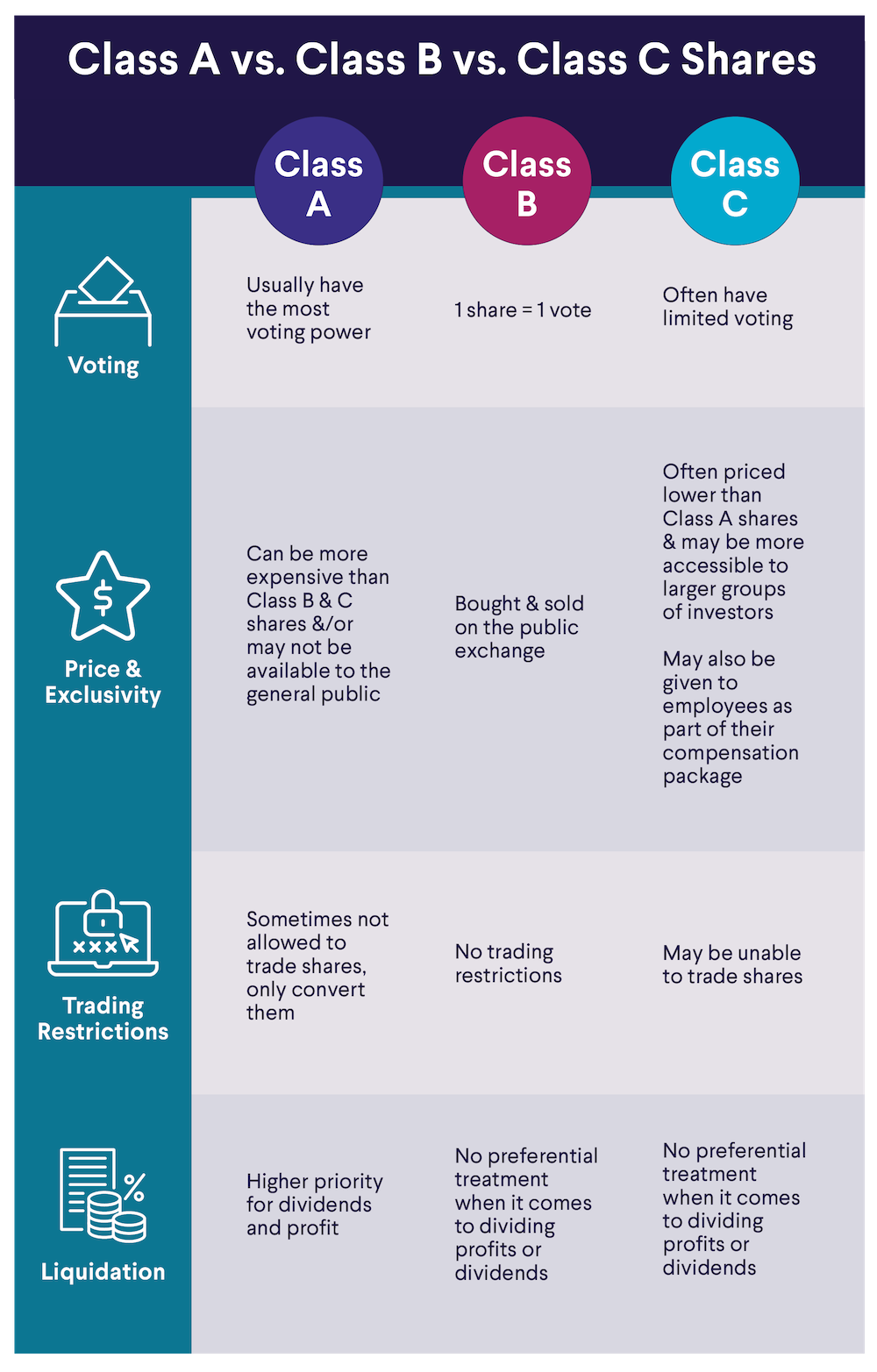
Note that the chart below represents common definitions of Class A, B, and C shares, but that companies may structure their own stock classes differently.

Class A vs Class B vs Class C Shares

What Are Dual Class Shares?

Companies that offer more than one class of shares have “dual class shares.” This is a fairly common practice, and some companies offer dual class shares that automatically convert to a common share with voting privilege at a set period of time.

Why Some Companies Use Dual Class Shares

Some companies may use dual class shares if they hope to IPO, and do not want public investors to have a say in the company’s decision-making. There has been controversy about companies offering two share classes of stock to the public, with detractors concerned that multiple share classes may lead to governance issues, such as reduced accountability. But others argue that multiple share classes can be an asset for a public company, leading to improved performance.

Examples of Companies With Dual Class Shares

There are numerous companies that use dual class share systems. Here are some examples of some of most recognizable:

•   Alphabet (Google)

•   Berkshire Hathaway

•   Meta

•   Ford

•   Nike

The Takeaway

Class A, Class B, and Class C shares have different voting rights and different levels of access to distributions and dividends. It can be difficult to determine which investment class is the best option for you if you’re deciding to invest in a public company that offers multiple share classes. Beyond market price, understanding how the stock will function in your overall portfolio as well as your personal investing philosophy can help guide you choose the best share class for you.

For example, investors who may be looking for shorter-term investments may choose a stock class without voting privileges. Other investors who want to be active in corporate governance may prefer share classes that come with voting rights. And some investors may be looking for stocks that provide guaranteed dividends, which may guide their decision toward one class of shares.

Invest in what matters most to you with SoFi Active Invest. In a self-directed account provided by SoFi Securities, you can trade stocks, exchange-traded funds (ETFs), mutual funds, alternative funds, options, and more — all while paying $0 commission on every trade. Other fees may apply. Whether you want to trade after-hours or manage your portfolio using real-time stock insights and analyst ratings, you can invest your way in SoFi's easy-to-use mobile app.

Opening and funding an Active Invest account gives you the opportunity to get up to $1,000 in the stock of your choice.¹

FAQ

Are there specific types of businesses that prefer Class A, Class B, or Class C shares?

Not necessarily, as how each share class is structured is typically done for different strategic reasons. As such, some companies in certain industries may operate in similar manners, but it doesn’t mean their share structures would necessarily follow suit.

Do Class B shares always have fewer voting rights than Class A shares?

Class B shares often, or commonly have fewer voting rights than Class A shares, but it’s not always the case. Some companies structure their shares such that Class B shares actually have more voting rights than Class A shares.

Can investors convert Class B or C shares into Class A shares?

Some investors are able to convert their Class B or C shares into Class A shares, depending on the specific stock.

Why do some companies prefer dual class share structures?

Some companies might use dual class share structures in order to concentrate voting power among a select group of investors, rather than leave it to the whims of public or retail investors.

How do different share classes impact dividend payments?

Broadly speaking, different share classes often have different dividend payments, and that can depend on numerous factors.


Photo credit: iStock/g-stockstudio

INVESTMENTS ARE NOT FDIC INSURED • ARE NOT BANK GUARANTEED • MAY LOSE VALUE

SoFi Invest is a trade name used by SoFi Wealth LLC and SoFi Securities LLC offering investment products and services. Robo investing and advisory services are provided by SoFi Wealth LLC, an SEC-registered investment adviser. Brokerage and self-directed investing products offered through SoFi Securities LLC, Member FINRA/SIPC.

For disclosures on SoFi Invest platforms visit SoFi.com/legal. For a full listing of the fees associated with Sofi Invest please view our fee schedule.

Financial Tips & Strategies: The tips provided on this website are of a general nature and do not take into account your specific objectives, financial situation, and needs. You should always consider their appropriateness given your own circumstances.


¹Probability of Member receiving $1,000 is a probability of 0.026%; If you don’t make a selection in 45 days, you’ll no longer qualify for the promo. Customer must fund their account with a minimum of $50.00 to qualify. Probability percentage is subject to decrease. See full terms and conditions.

Disclaimer: The projections or other information regarding the likelihood of various investment outcomes are hypothetical in nature, do not reflect actual investment results, and are not guarantees of future results.

Mutual Funds (MFs): Investors should carefully consider the information contained in the prospectus, which contains the Fund’s investment objectives, risks, charges, expenses, and other relevant information. You may obtain a prospectus from the Fund company’s website or clicking the prospectus link on the fund's respective page at sofi.com. You may also contact customer service at: 1.855.456.7634. Please read the prospectus carefully prior to investing.Mutual Funds must be bought and sold at NAV (Net Asset Value); unless otherwise noted in the prospectus, trades are only done once per day after the markets close. Investment returns are subject to risk, include the risk of loss. Shares may be worth more or less their original value when redeemed. The diversification of a mutual fund will not protect against loss. A mutual fund may not achieve its stated investment objective. Rebalancing and other activities within the fund may be subject to tax consequences.

Investment Risk: Diversification can help reduce some investment risk. It cannot guarantee profit, or fully protect in a down market.

Investing in an Initial Public Offering (IPO) involves substantial risk, including the risk of loss. Further, there are a variety of risk factors to consider when investing in an IPO, including but not limited to, unproven management, significant debt, and lack of operating history. For a comprehensive discussion of these risks please refer to SoFi Securities’ IPO Risk Disclosure Statement. This should not be considered a recommendation to participate in IPOs and investors should carefully read the offering prospectus to determine whether an offering is consistent with their investment objectives, risk tolerance, and financial situation. New offerings generally have high demand and there are a limited number of shares available for distribution to participants. Many customers may not be allocated shares and share allocations may be significantly smaller than the shares requested in the customer’s initial offer (Indication of Interest). For more information on the allocation process please visit IPO Allocation Procedures.

SOIN-Q225-154

Read more
woman with glasses on laptop

Actively Managed Funds vs Index Funds: Differences and Similarities

Actively managed funds and index funds are similar in that they’re both a type of pooled investment fund, and they both come in a variety of styles (e.g., large cap, small cap, green bonds, and so on). The main difference between them is that actively managed funds rely on a team of live portfolio managers vs. index funds, which simply track or mirror a relevant index using an algorithm.

The difference in management style between active and so-called “passive” index funds leads to a series of other differences, including cost and transparency around securities in the fund. Further, the debate concerning the merits of actively managed funds vs. index funds is a longstanding one. Both types of funds have the potential to yield advantages to investors. But they each have drawbacks that should be weighed in the balance.

Key Points

•   Actively managed funds aim to outperform the market through professional selection of securities.

•   Index funds mirror a benchmark index, offering passive investment.

•   Higher costs are typical for actively managed funds due to the expense of portfolio managers and frequent trading.

•   Index funds are generally more tax efficient, with lower turnover and fewer capital gains.

•   Pros of actively managed funds include potential for higher returns; index funds may offer lower costs and more predictable performance.

What Are Index Funds?

Index funds are a type of mutual fund or exchange-traded fund (ETF) that mirror the performance of a specific stock market index.

A stock market index measures a particular sector of the market. In the case of the S&P 500 Index, for example, what’s being measured is the performance of the 500 largest U.S. companies.

While it’s not possible to invest in an index directly, index funds and ETFs offer a work-around because when you invest in an index fund, you’re purchasing a fund that holds securities which are representative of its representative index.

If you’re buying a fund that tracks the Nasdaq-100 Composite Index, for example, the fund would include stocks from the 100 largest and most actively-traded non-financial domestic and international securities listed on the Nasdaq. The securities are not hand-picked by a portfolio manager, and an index fund doesn’t seek to outperform the benchmark — but rather, to match it.

Index funds can be cap-weighted, meaning they track an index that relies on market capitalization to decide which securities to include. Market capitalization is a company’s value as determined by its share price multiplied by the number of shares outstanding.

For example, some index funds only track large-cap companies that have a market capitalization of more than $10 billion. Others focus on small-cap companies that have a market capitalization of $250 million to $2 billion.

Index funds and index investing follow a passive investment strategy. That means that the fund tracks the performance of a particular benchmark, rather than trying to beat the market by using the skills of a live portfolio manager.

What Are Actively Managed Funds?

Actively managed ETFs and mutual funds also represent a collection or basket of securities. The difference between these types of funds and index funds is that instead of being passively managed and tracking a specific index, a fund manager plays a hands-on role in determining which securities to include, in an attempt to outperform benchmarks.

Because of that, fund turnover — the movement of assets in and out of the fund — may be more frequent compared to an index fund. This has certain tax and cost implications for investors.

Index Funds vs Actively Managed Funds

Index funds do have some similarities to actively managed funds, but the chief difference between them — i.e. the use of passive management vs. active management — yields some important other differences.

Index Funds

Active Funds

Types of securities All securities (stocks, bonds, etc.) All securities (stocks, bonds, etc.)
Investment objective To mirror its benchmark To outperform its benchmark
Management style Passive (securities in the fund match the index) Active (fund managers select securities in the fund on the basis of performance)
Cost Average expense ratio is about 0.03 to 0.05% Average expense ratio is about 0.50% to 0.75%
Tax efficiency Less turnover, more tax efficient Higher turnover, less tax efficient

Similarities

As noted above, both types of funds are pooled investment funds. You might have passively or actively managed mutual funds as well as exchange-traded funds.

Both types of funds can be invested in a wide range of different equities, bonds, and other securities. For example, you might have a small-cap ETF that’s passively managed (perhaps it tracks the Russell 2000 small-cap index) or an ETF that’s actively managed and also invested in small-cap companies.

Differences

The chief differences between actively managed funds show up in terms of cost and tax implications, and performance.

Actively managed funds are generally more expensive than index funds, because the fund employs a team of active managers who hand-pick securities and trade them. Active funds also have a different investment objective: to outperform benchmarks. Index funds merely seek to mirror the performance of its benchmark index.

So a large-cap actively managed fund might seek to outperform the S&P 500, whereas a large-cap index fund that tracks the S&P 500 would aim to deliver the same results as the index itself.


💡 Quick Tip: When you’re actively investing in stocks, it’s important to ask what types of fees you might have to pay. For example, brokers may charge a flat fee for trading stocks, or require some commission for every trade. Taking the time to manage investment costs can be beneficial over the long term.

Pros and Cons of Index Funds

There’s a lot to like about index funds but with any investment, it’s important to consider the potential downsides. Reading through an index fund’s prospectus can offer more insight into how the particular fund works, in terms of what it invests in, its risk profile, and the costs you’ll pay to own it. This can help you better gauge whether a particular index fund aligns with your investment strategy.

When weighing index funds as a whole, here are some important points to keep in mind.

Index Fund Pros

•   Simplified diversification. Diversification may help manage risk inside a portfolio. Index funds can make diversifying easier through exposure to multiple securities that represent a specific index.

•   Cost. Because they are passively managed, index funds typically charge fewer fees and carry expense ratios that are well below the industry average of 0.57%. Fewer fees allow you to keep more of your investment returns.

•   Tax efficient. Index funds tend to turn over assets less frequently than actively managed funds, which means fewer capital gains tax events — another way index funds can save investors money.

•   Consistent performance. The idea behind an index fund is that it will closely track its benchmark to mirror performance. Index funds may offer stable returns over time when they perform in tandem with their respective indices.

Index Fund Cons

•   Underperformance. Index fund returns can differ from one fund to the next and factors such as fees, expense ratios, and market conditions can affect how well a fund performs. It’s possible that rather than matching its benchmark, an index fund may deliver returns below expectations.

•   Cost. Between index funds vs. managed funds, index funds tend to have lower costs — but that’s not always the case. It’s possible to invest in index funds that prove more expensive than actively managed funds.

•   Tracking error. Tracking error occurs when an index fund’s performance doesn’t match the performance of its benchmark. This can happen if the fund’s makeup doesn’t accurately reflect the makeup of securities tracked by the index.

•   Limit on returns. Index funds aren’t designed to outperform a benchmark. Investing in these funds, without considering active investing strategies, could limit your return potential over time and cause you to miss out on bigger investment gains.

Why Invest in Index Funds?

Index funds and index investing may work better for a buy-and-hold investor who’s focused on investing for the long-term. Buy-and hold-strategies often go hand in hand with value investing strategies, in which the emphasis lies on finding companies that are undervalued by the market.

Utilizing index funds could simplify investing over the long term, and it may suit people who want to minimize risk-taking in their portfolios. But it’s important to consider the trade-offs involved with choosing index funds vs. actively managed funds.

Pros and Cons of Actively Managed Funds

With active funds, fund managers use their knowledge and expertise to determine which securities to buy or sell inside the fund in order to reach the fund’s investment goals.

As with index investing, using actively managed funds to invest can have its high and low points. Here are some key things to know about investing with actively managed funds.

Actively Managed Funds Pros

•   Professional expertise. Actively managed funds allow investors to benefit from a fund manager’s know-how and experience in the market. This may be reassuring to an investor who’s still learning the ropes of how trading works, or who has faith in a particular fund manager.

•   Higher returns. Actively managed funds seek to outperform the market. If the fund realizes its objectives, returns could possibly exceed those offered by index funds. Historically, though, the majority of active funds don’t consistently outperform the market.

Actively Managed Funds Cons

•   Underperformance. As with index funds, it’s possible that an actively managed fund’s returns won’t meet investor expectations. This can happen if the fund manager makes a miscalculation when choosing securities or unforeseen events, such as a major economic downturn, deliver a blow to the market.

•   High management fees. The costs associated with having a fund manager make decisions are typically higher than with passively managed index funds.

•   Risk. Active trading can be riskier than index investing, since performance relies on the fund manager to make buying and selling decisions.

•   Taxes. Since asset turnover may be higher for actively managed funds, more capital gains tax events are likely. Even though an actively managed fund may generate higher returns, those have to be weighed against the possibility of increased tax liability.

Why Invest in Actively Managed Funds

Actively managed funds may offer more downside than upside to investors. Unlike index funds, actively managed funds may not be suited for a long-term, buy-and-hold strategy. But for investors who have the time or inclination to take their chances for a greater potential yield, they might be an attractive part of a portfolio.

Are Index Funds Better Than Managed Funds?

Both actively managed funds and index funds aim to help investors achieve their goals, but in different ways and with potentially different results. Whether index funds or managed funds are better hinges largely on the individual investor and what they need or expect their investments to do for them.

When considering index funds and actively managed funds, ask yourself what’s more important: Steady returns or a chance to outperform the market? While actively managed funds can outperform market indices, results aren’t guaranteed and in some cases, active funds can lag behind their benchmarks.

Index funds, on the other hand, may offer a greater sense of stability over time and potentially more insulation against market volatility. While all investments carry the risk of loss, over time there may be a smaller chance of losing money in an index fund. But there are no guarantees.

Potential lower investment costs can also be attractive when estimating net returns, but again it’s important to compare fund costs against fund performance individually, to ensure that you’re comfortable with the number.

The Takeaway

Whether you prefer index funds vs. managed funds might depend on your age, time horizon for investing, risk tolerance, and goals. If you lean toward a hands-off, goals-based investing approach that carries lower costs, index investing could suit you well.

On the other hand, if you’re more interested in beating the market, and if you believe active management is more likely to deliver outperformance, then you may consider the benefits of active investing.

Invest in what matters most to you with SoFi Active Invest. In a self-directed account provided by SoFi Securities, you can trade stocks, exchange-traded funds (ETFs), mutual funds, alternative funds, options, and more — all while paying $0 commission on every trade. Other fees may apply. Whether you want to trade after-hours or manage your portfolio using real-time stock insights and analyst ratings, you can invest your way in SoFi's easy-to-use mobile app.

Opening and funding an Active Invest account gives you the opportunity to get up to $1,000 in the stock of your choice.¹

FAQ

What is an actively-managed fund?

Actively-managed funds are funds (such as ETFs or mutual funds) that are overseen by a fund manager, who has a hands-on role in deciding which investments the fund invests in. Conversely, a passive fund may simply track a market index.

What is a primary difference between index and active funds?

One primary difference between index and active funds is that index funds seek to merely mirror the performance of a benchmark, whereas an active fund is hoping to outperform it. Costs may be significantly higher for active funds, too.

Are active funds more expensive than index funds?

Generally, yes, the fees associated with active funds are higher than index funds because a fund manager is at the helm, taking a hands-on approach.


INVESTMENTS ARE NOT FDIC INSURED • ARE NOT BANK GUARANTEED • MAY LOSE VALUE

SoFi Invest is a trade name used by SoFi Wealth LLC and SoFi Securities LLC offering investment products and services. Robo investing and advisory services are provided by SoFi Wealth LLC, an SEC-registered investment adviser. Brokerage and self-directed investing products offered through SoFi Securities LLC, Member FINRA/SIPC.

For disclosures on SoFi Invest platforms visit SoFi.com/legal. For a full listing of the fees associated with Sofi Invest please view our fee schedule.

Financial Tips & Strategies: The tips provided on this website are of a general nature and do not take into account your specific objectives, financial situation, and needs. You should always consider their appropriateness given your own circumstances.

Disclaimer: The projections or other information regarding the likelihood of various investment outcomes are hypothetical in nature, do not reflect actual investment results, and are not guarantees of future results.

Mutual Funds (MFs): Investors should carefully consider the information contained in the prospectus, which contains the Fund’s investment objectives, risks, charges, expenses, and other relevant information. You may obtain a prospectus from the Fund company’s website or clicking the prospectus link on the fund's respective page at sofi.com. You may also contact customer service at: 1.855.456.7634. Please read the prospectus carefully prior to investing.Mutual Funds must be bought and sold at NAV (Net Asset Value); unless otherwise noted in the prospectus, trades are only done once per day after the markets close. Investment returns are subject to risk, include the risk of loss. Shares may be worth more or less their original value when redeemed. The diversification of a mutual fund will not protect against loss. A mutual fund may not achieve its stated investment objective. Rebalancing and other activities within the fund may be subject to tax consequences.

Exchange Traded Funds (ETFs): Investors should carefully consider the information contained in the prospectus, which contains the Fund’s investment objectives, risks, charges, expenses, and other relevant information. You may obtain a prospectus from the Fund company’s website or by emailing customer service at [email protected]. Please read the prospectus carefully prior to investing.

Investment Risk: Diversification can help reduce some investment risk. It cannot guarantee profit, or fully protect in a down market.

S&P 500 Index: The S&P 500 Index is a market-capitalization-weighted index of 500 leading publicly traded companies in the U.S. It is not an investment product, but a measure of U.S. equity performance. Historical performance of the S&P 500 Index does not guarantee similar results in the future. The historical return of the S&P 500 Index shown does not include the reinvestment of dividends or account for investment fees, expenses, or taxes, which would reduce actual returns.
Fund Fees
If you invest in Exchange Traded Funds (ETFs) through SoFi Invest (either by buying them yourself or via investing in SoFi Invest’s automated investments, formerly SoFi Wealth), these funds will have their own management fees. These fees are not paid directly by you, but rather by the fund itself. these fees do reduce the fund’s returns. Check out each fund’s prospectus for details. SoFi Invest does not receive sales commissions, 12b-1 fees, or other fees from ETFs for investing such funds on behalf of advisory clients, though if SoFi Invest creates its own funds, it could earn management fees there.
SoFi Invest may waive all, or part of any of these fees, permanently or for a period of time, at its sole discretion for any reason. Fees are subject to change at any time. The current fee schedule will always be available in your Account Documents section of SoFi Invest.


Third-Party Brand Mentions: No brands, products, or companies mentioned are affiliated with SoFi, nor do they endorse or sponsor this article. Third-party trademarks referenced herein are property of their respective owners.

Tax Information: This article provides general background information only and is not intended to serve as legal or tax advice or as a substitute for legal counsel. You should consult your own attorney and/or tax advisor if you have a question requiring legal or tax advice.

Third Party Trademarks: Certified Financial Planner Board of Standards Center for Financial Planning, Inc. owns and licenses the certification marks CFP®, CERTIFIED FINANCIAL PLANNER®


¹Probability of Member receiving $1,000 is a probability of 0.026%; If you don’t make a selection in 45 days, you’ll no longer qualify for the promo. Customer must fund their account with a minimum of $50.00 to qualify. Probability percentage is subject to decrease. See full terms and conditions.

SOIN-Q225-129

Read more
TLS 1.2 Encrypted
Equal Housing Lender