What Is UCITS?

What Are UCITS Funds?

UCITS, or Undertakings for Collective Investment in Transferable Securities, refers to a set of guidelines that allow pooled securities, similar to mutual funds, to be traded across borders within the European Union.

As such, UCITS is essentially a framework or directive that governs the composition and trading of UCITS funds.

UCITS funds are registered in individual EU countries and must comply with European Commission rules. Investors in the U.S. may also access these funds via authorized brokers. UCITS may be available in other regions, like Asia, as well.

Key Points

•   UCITS refers to a set of guidelines that allows a certain type of mutual fund to be traded freely across country borders within the EU.

•   UCITS funds are a type of mutual fund that complies with European Union regulations and holds securities from throughout the region.

•   The rules for UCITS funds are periodically updated, with each new version noted by a Roman numeral.

•   Although these are considered EU securities, U.S. investors can purchase these funds through an authorized broker.

•   UCITS funds are highly regulated, and investors outside the EU may face tax events when trading these funds.

What Is a UCITS Fund?

UCITS funds are a type of mutual fund that complies with European Union regulations. These securities can be traded across the borders of EU member states.

The EU launched UCITS for two primary reasons:

1.    To structure a type of security under the EU umbrella that allowed for the cross-border sale of mutual funds throughout the EU, and across other markets.

2.    To better regulate investment asset transactions among all EU member countries, giving investors inside and outside of the EU access to more tightly regulated investment funds.

Fundamentally, UCITS rules give EU regulators a powerful tool to centralize key financial services issues like types of investments allowed, asset liquidity, investment disclosures, and investor safeguards. By rolling the new rules and regulations into UCITS, EU regulators sought to make efficient and secure investment funds available to a broad swath of investors.

For investors, UCITS funds offer flexibility and security. Not only are the funds widely viewed as safe and secure owing to the level of regulation, but UCITS funds offer a diversified fund option to investors who might otherwise have to depend on single public companies for the bulk of their investment portfolios.

A Brief History of UCITS

The genesis of UCITS funds dates back to the mid-1980’s, with the rollout of the European Directive legislation, which set a new blueprint for financial markets across the continent. The new law introduced UCITS funds on an incremental basis and has been used as a way to regulate financial markets with regular updates and revisions over the past three decades.

In 2002, the EU issued a pair of new directives related to mutual fund sales — Directives 2001/107/EC and 2001/108/EC, which expanded the market for UCITS across the EU and loosened regulations on the sale of index funds in the region.

The fund initiative accelerated in 2009 and 2010, when the Directive 2009/65/EC of the European Parliament and of the Council of 13 July 2009 clarified the use of UCITS in European investment markets, especially in coordination of all laws, regulations, and administrative oversight. The next year, the European Union reclassified UCITS w as investment funds regulated under Part 1 of the Law of 17 December 2010.

In recent years, “Alt UCITS” or alternative UCITS funds have grown in popularity, along with other types of alternative investments.

How Does a UCIT Fund Work?

Structurally, UCITS are built like mutual funds, with many of the same features, regulatory requirements, and marketing models.

Individual and institutional investors, who form a collective group of unit holders, put their money into a UCIT, which, in turn, owns investment securities (mostly stocks and bonds) and cash. For investors, the primary goal is to invest their money into the fund to capitalize on specific market conditions that favor the stocks or bonds that form the UCITS.

UCITS funds may provide one way for American investors to get more international diversification within their portfolios.

A professional money manager, or group of managers, run the fund, and they are singularly responsible for choosing the securities that make up the fund. The UCITS investor understands this agreement before investing in the fund, thus allowing the fund managers to choose investments on their behalf.

An investor may leave the fund at any point in time, and do so by liquidating their shares of the fund on the open market. American investors should know that the Internal Revenue Service may classify UCITS as passive foreign investment companies, which could trigger more onerous tax treatments, especially when compared to domestic mutual funds.


💡 Quick Tip: How to manage potential risk factors in a self-directed investment account? Doing your research and employing strategies like dollar-cost averaging and diversification may help mitigate financial risk when trading stocks.

UCITS Rules and Regulations

UCITS do have some firm regulatory and operational requirements to abide by in the European Union, as follows:

•   The fund and its management team are usually based on a tax-neutral EU country (Ireland would be a good example).

•   A UCITS fund operates under the laws mandated by the member state of its headquarters. After the fund is licensed in the EU state of origin, it can then be marketed to other EU states, and to investors around the world. The fund must provide proper legal notification to the state or nation where it wants to do business before being allowed to market the fund to investors.

•   A UCITS fund must provide proper notice to investors in the form of a Key Investor Information Document, usually located on the fund’s website. The fund must also be approved.

•   A UCITS fund must also provide a fund prospectus to investors (also normally found on the fund’s web site) and must file both annual and semiannual reports.

•   Any time a UCITS company issues, sells, or redeems fund shares, it must make pricing notification available to investors.

The Takeaway

Undertakings for Collective Investment in Transferable Securities (UCITS) is a category of investment funds primarily available in the EU, but investors in the U.S. may access these funds through authorized brokers.

UCITS may be an interesting type of investment for U.S. investors looking to diversify their portfolios. As with any investment, investors must conduct thorough due diligence on a UCITS security, which should include a review of fund holdings, past performance, management stability, fees, and tax consequences.

FAQ

What is UCITS in simple terms?

UCITS is a set of guidelines governing a type of mutual fund in the EU. It stands for: “undertaking for collective investment in transferable securities.” This means it’s a type of pooled investment, similar to a U.S. mutual fund, that invests in securities like stocks, bonds, short-term government bonds, and cash.

What is a non-UCITS fund?

A non-UCITS fund does not comply with UCITS guidelines. For example, a non-UCITS fund might not be open-ended or it might be illiquid — two primary UCITS requirements.

What are the disadvantages of UCITS?

UCITS funds may have higher costs, owing to the regulatory requirements governing securities in the EU. Also, because the UCITS standards can be restrictive, these funds may not be able to take advantage of certain market conditions. UCITS funds can also have higher tax consequences for U.S. investors.


Photo credit: iStock/kupicoo

INVESTMENTS ARE NOT FDIC INSURED • ARE NOT BANK GUARANTEED • MAY LOSE VALUE

SoFi Invest is a trade name used by SoFi Wealth LLC and SoFi Securities LLC offering investment products and services. Robo investing and advisory services are provided by SoFi Wealth LLC, an SEC-registered investment adviser. Brokerage and self-directed investing products offered through SoFi Securities LLC, Member FINRA/SIPC.

For disclosures on SoFi Invest platforms visit SoFi.com/legal. For a full listing of the fees associated with Sofi Invest please view our fee schedule.

Mutual Funds (MFs): Investors should carefully consider the information contained in the prospectus, which contains the Fund’s investment objectives, risks, charges, expenses, and other relevant information. You may obtain a prospectus from the Fund company’s website or clicking the prospectus link on the fund's respective page at sofi.com. You may also contact customer service at: 1.855.456.7634. Please read the prospectus carefully prior to investing.Mutual Funds must be bought and sold at NAV (Net Asset Value); unless otherwise noted in the prospectus, trades are only done once per day after the markets close. Investment returns are subject to risk, include the risk of loss. Shares may be worth more or less their original value when redeemed. The diversification of a mutual fund will not protect against loss. A mutual fund may not achieve its stated investment objective. Rebalancing and other activities within the fund may be subject to tax consequences.

Fund Fees
If you invest in Exchange Traded Funds (ETFs) through SoFi Invest (either by buying them yourself or via investing in SoFi Invest’s automated investments, formerly SoFi Wealth), these funds will have their own management fees. These fees are not paid directly by you, but rather by the fund itself. these fees do reduce the fund’s returns. Check out each fund’s prospectus for details. SoFi Invest does not receive sales commissions, 12b-1 fees, or other fees from ETFs for investing such funds on behalf of advisory clients, though if SoFi Invest creates its own funds, it could earn management fees there.
SoFi Invest may waive all, or part of any of these fees, permanently or for a period of time, at its sole discretion for any reason. Fees are subject to change at any time. The current fee schedule will always be available in your Account Documents section of SoFi Invest.


Tax Information: This article provides general background information only and is not intended to serve as legal or tax advice or as a substitute for legal counsel. You should consult your own attorney and/or tax advisor if you have a question requiring legal or tax advice.

Investment Risk: Diversification can help reduce some investment risk. It cannot guarantee profit, or fully protect in a down market.

Disclaimer: The projections or other information regarding the likelihood of various investment outcomes are hypothetical in nature, do not reflect actual investment results, and are not guarantees of future results.

Financial Tips & Strategies: The tips provided on this website are of a general nature and do not take into account your specific objectives, financial situation, and needs. You should always consider their appropriateness given your own circumstances.

SOIN-Q225-098

Read more
Class A vs Class B vs Class C Shares, Explained

Class A vs Class B vs Class C Shares, Explained

Class A, Class B, and Class C shares are different categories of company shares that have different voting rights and different levels of access to distributions and dividends. Companies may use these tiers so that certain key shareholders, such as founders or executives, have more voting power than ordinary shareholders. These shareholders also may have priority on the company’s profits and assets, and may have different access to dividends.

Not all companies have alternate stock classes. And what can make share categories even more complicated is that while the classifications are common, each company can define their stock classes, meaning that they can vary from company to company. That makes it even more important for investors to know exactly what they’re getting when they purchase a certain type of stock.

Key Points

•   Class A, Class B, and Class C shares are different categories of company stock with varying voting rights and access to dividends.

•   Companies may use different share classes to give certain shareholders more voting power and priority on profits.

•   Share classes can vary from company to company, making it important for investors to understand the specific terms and differences.

•   Class A shares generally have more voting power and higher priority for dividends, while Class B shares are common shares with no preferential treatment.

•   Class C shares can refer to shares given to employees or alternate share classes available to public investors, with varying restrictions and voting rights.

Why Companies Have Different Types of Stock Shares

When a company goes public, it sells portions of itself, known as stocks or shares, to shareholders.

Shareholders own a portion of the company’s assets and profits and have a say in how the company is governed. To help mitigate risk and retain majority control of the company, a company can restrict the amount of stock they sell and retain majority ownership in the company. Or, it can create different shareholder classes with different rights.

By creating multiple shareholder classes when they go public, a company can ensure that executives maintain control of the company and have more influence over business decisions. For example, while ordinary shareholders, or Class B shareholders, may have one vote per share owned, individuals with executive shares, or Class A shares, may have 100 votes per share owned. Executives also may get first priority of profits, which can be important in the case of an acquisition or closure, where there is only a finite amount of profit.

Different stock classes can also reward early investors. For example, some companies may designate Class A investors as those who invested with the company prior to a certain time period, such as a merger. These investors may have more votes per share and rights to dividends than Class B investors. A company’s charter, perspective, and bylaws should outline the differences between the classes.

Class differentiation has become more critical in creating a portfolio in recent years because investors have access to different classes in a way they may not have had access in the past. For example, mutual funds frequently divide their shares into A, B, and C class shares based on the type of investor they want to attract.

The Different Types of Shares

Just like there are different types of stock, there are different types of shareholders. Because different stock classes have such different terms, depending on the company, investors may use additional terminology to describe the stock they hold. This can include:

Preferred Shares

Investors who buy preferred shares may not have voting rights, but may have access to a regular dividend that may not be available to shareholders of common stock.

Common Shares

Sometimes called “ordinary shares,” common shares are stocks bought and measured on the market. Owners have voting rights. They may have dividends and access to profits, though they may come after other investors, such as executive shareholders and preferred shareholders have been paid.

Nonvoting Shares

These are typically offered by private companies or as part of a compensation package to employees. Companies may use non voting shares so employees and former employees don’t have an outsize influence in company decision-making, or so that power remains consolidated with the executive board and outside shareholders. Some companies create a separate class of stock, Class C stock, that comes without voting rights and that may be less expensive than other classes.

Executive Shares

Typically, these shares are held by founders or company executives. Their stock may have outsize voting rights and may also have restrictions on the ability to sell the shares. Executive shares usually do not trade on the public markets.

Advisory Shares

Often offered to advisors or large investors of a company, these shares may have preferred rights and do not trade on public markets.

Restricted Shares

Restricted shares are called so because they come with strings attached, typically having to do with whether they can be sold or transferred. For instance, an employee of a company may earn restricted shares as a part of their compensation package, and aren’t able to sell them until after a certain period of time.

Treasury Shares

Treasury shares are shares that a company purchases back from the open market from shareholders. When you hear of stock “buybacks,” this is typically what that term is referring to. In effect, a company is reabsorbing its shares, and reducing the total outstanding stock on the market.

Recommended: Shares vs. Stocks: Differences to Know

Get up to $1,000 in stock when you fund a new Active Invest account.*

Access stock trading, options, alternative investments, IRAs, and more. Get started in just a few minutes.


*Customer must fund their Active Invest account with at least $50 within 45 days of opening the account. Probability of customer receiving $1,000 is 0.026%. See full terms and conditions.

What Are Class A Shares?

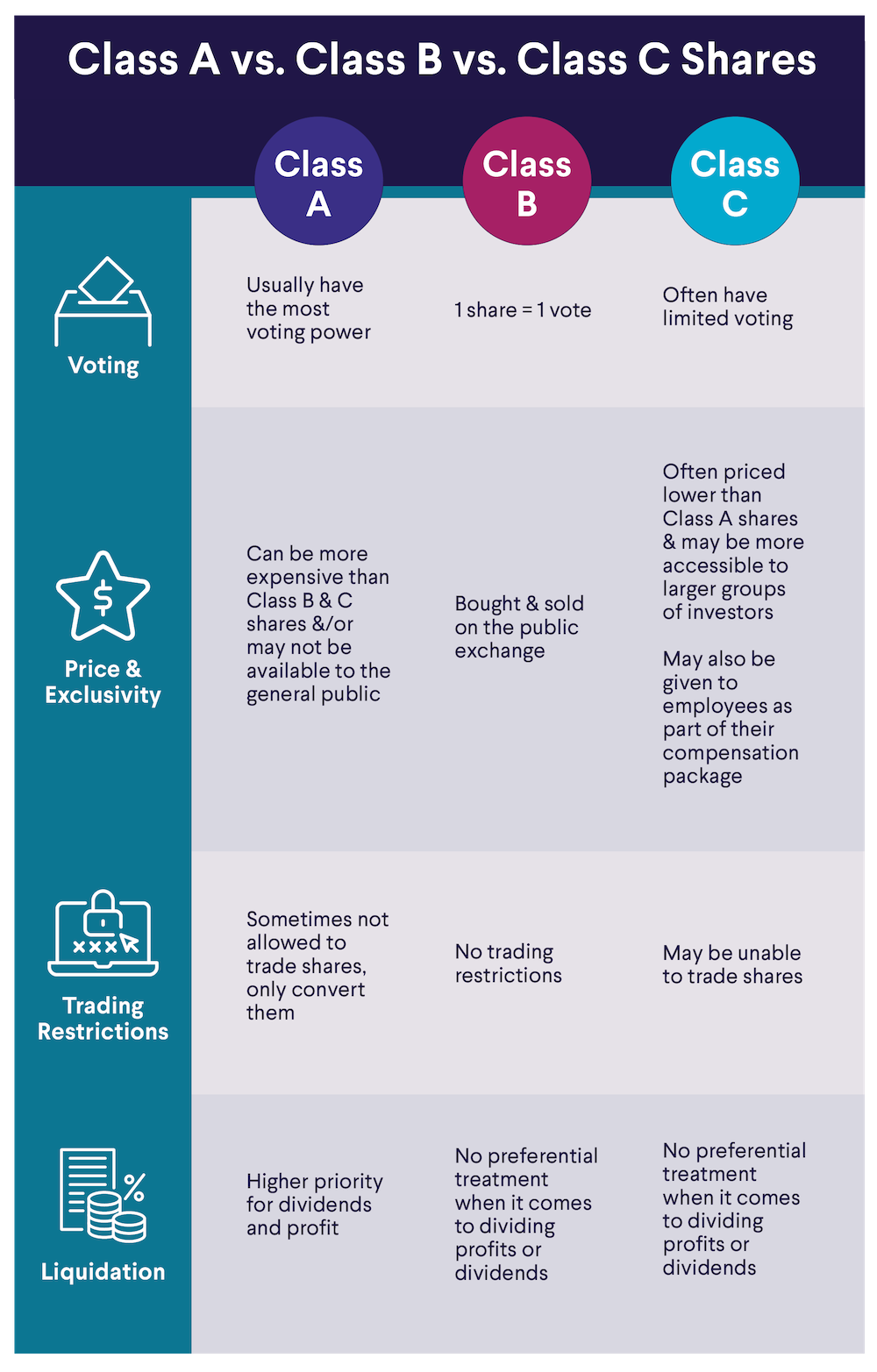
While the specific attributes of Class A shares depend on the company, they generally come with more voting power and a higher priority for dividends and profit in the event of liquidation. Class A shares may be more expensive than Class B shares, or may not be available to the general public.

Advantages and Disadvantages of Class A Shares

Class A shares have some advantages and disadvantages over other types of shares. But again, it all comes down to the specifics.

Many companies can have different stock tiers that trade at different prices. For instance, Company X may have Class A stock that regularly trades at hundreds of thousands of dollars while its Class B stock may trade for hundreds of dollars per share.

Class B stockholders may also only have a small percentage of the vote that a Class A stockholder has. And while Class A stockholders might be able to convert their shares into Class B shares, a Class B shareholder may not be able to convert their shares into Class A shares.

Many of the tech companies that have gone public in recent years have also used a dual-share class system.

In some cases, shareholders are not allowed to trade their Class A shares, so they have a conversion that allows the owner to convert them into Class B, which they can sell or trade. Executives may also be able to sell their shares in a secondary offering, following the IPO.


💡 Quick Tip: Distributing your money across a range of assets — also known as diversification — can be beneficial for long-term investors. When you put your eggs in many baskets, it may be beneficial if a single asset class goes down.

What Are Class B Shares?

Often companies refer to their Class B shares as “common shares” or “ordinary shares,” (But occasionally, companies flip the definition and have Class A shares designated as common shares and Class B shares as founder and executive shares).

Advantages and Disadvantages of Class B Shares

Class B shares are generally liquid, meaning that investors can buy and sell common shares on a public stock exchange, where, typically, one share equals one vote. However, Class B shares carry no preferential treatment when it comes to dividing profits or dividends.

What Are Class C Shares?

Some companies also offer Class C shares, which they may give to employees as part of their compensation package. The difference between Class C and common stock shares can be subtle.

It’s important to note that these stock classes vary depending on the company. So doing research and understanding exactly which type of shares you’re buying is key before you commit to purchasing a certain class of stock.

Advantages and Disadvantages of Class C Shares

Class C shares may have specific restrictions, such as an inability to trade the shares.

Class C shares also may also refer to alternate share classes available to public investors. Often priced lower than Class A shares and with restrictions on voting rights, these shares may be more accessible to larger groups of investors. But this is not always the case. For example, Alphabet has Class A and Class C shares. Both tend to trade at similar prices.

Note that the chart below represents common definitions of Class A, B, and C shares, but that companies may structure their own stock classes differently.

Class A vs Class B vs Class C Shares

What Are Dual Class Shares?

Companies that offer more than one class of shares have “dual class shares.” This is a fairly common practice, and some companies offer dual class shares that automatically convert to a common share with voting privilege at a set period of time.

Why Some Companies Use Dual Class Shares

Some companies may use dual class shares if they hope to IPO, and do not want public investors to have a say in the company’s decision-making. There has been controversy about companies offering two share classes of stock to the public, with detractors concerned that multiple share classes may lead to governance issues, such as reduced accountability. But others argue that multiple share classes can be an asset for a public company, leading to improved performance.

Examples of Companies With Dual Class Shares

There are numerous companies that use dual class share systems. Here are some examples of some of most recognizable:

•   Alphabet (Google)

•   Berkshire Hathaway

•   Meta

•   Ford

•   Nike

The Takeaway

Class A, Class B, and Class C shares have different voting rights and different levels of access to distributions and dividends. It can be difficult to determine which investment class is the best option for you if you’re deciding to invest in a public company that offers multiple share classes. Beyond market price, understanding how the stock will function in your overall portfolio as well as your personal investing philosophy can help guide you choose the best share class for you.

For example, investors who may be looking for shorter-term investments may choose a stock class without voting privileges. Other investors who want to be active in corporate governance may prefer share classes that come with voting rights. And some investors may be looking for stocks that provide guaranteed dividends, which may guide their decision toward one class of shares.

Invest in what matters most to you with SoFi Active Invest. In a self-directed account provided by SoFi Securities, you can trade stocks, exchange-traded funds (ETFs), mutual funds, alternative funds, options, and more — all while paying $0 commission on every trade. Other fees may apply. Whether you want to trade after-hours or manage your portfolio using real-time stock insights and analyst ratings, you can invest your way in SoFi's easy-to-use mobile app.

Opening and funding an Active Invest account gives you the opportunity to get up to $1,000 in the stock of your choice.¹

FAQ

Are there specific types of businesses that prefer Class A, Class B, or Class C shares?

Not necessarily, as how each share class is structured is typically done for different strategic reasons. As such, some companies in certain industries may operate in similar manners, but it doesn’t mean their share structures would necessarily follow suit.

Do Class B shares always have fewer voting rights than Class A shares?

Class B shares often, or commonly have fewer voting rights than Class A shares, but it’s not always the case. Some companies structure their shares such that Class B shares actually have more voting rights than Class A shares.

Can investors convert Class B or C shares into Class A shares?

Some investors are able to convert their Class B or C shares into Class A shares, depending on the specific stock.

Why do some companies prefer dual class share structures?

Some companies might use dual class share structures in order to concentrate voting power among a select group of investors, rather than leave it to the whims of public or retail investors.

How do different share classes impact dividend payments?

Broadly speaking, different share classes often have different dividend payments, and that can depend on numerous factors.


Photo credit: iStock/g-stockstudio

INVESTMENTS ARE NOT FDIC INSURED • ARE NOT BANK GUARANTEED • MAY LOSE VALUE

SoFi Invest is a trade name used by SoFi Wealth LLC and SoFi Securities LLC offering investment products and services. Robo investing and advisory services are provided by SoFi Wealth LLC, an SEC-registered investment adviser. Brokerage and self-directed investing products offered through SoFi Securities LLC, Member FINRA/SIPC.

For disclosures on SoFi Invest platforms visit SoFi.com/legal. For a full listing of the fees associated with Sofi Invest please view our fee schedule.

Financial Tips & Strategies: The tips provided on this website are of a general nature and do not take into account your specific objectives, financial situation, and needs. You should always consider their appropriateness given your own circumstances.


¹Probability of Member receiving $1,000 is a probability of 0.026%; If you don’t make a selection in 45 days, you’ll no longer qualify for the promo. Customer must fund their account with a minimum of $50.00 to qualify. Probability percentage is subject to decrease. See full terms and conditions.

Disclaimer: The projections or other information regarding the likelihood of various investment outcomes are hypothetical in nature, do not reflect actual investment results, and are not guarantees of future results.

Mutual Funds (MFs): Investors should carefully consider the information contained in the prospectus, which contains the Fund’s investment objectives, risks, charges, expenses, and other relevant information. You may obtain a prospectus from the Fund company’s website or clicking the prospectus link on the fund's respective page at sofi.com. You may also contact customer service at: 1.855.456.7634. Please read the prospectus carefully prior to investing.Mutual Funds must be bought and sold at NAV (Net Asset Value); unless otherwise noted in the prospectus, trades are only done once per day after the markets close. Investment returns are subject to risk, include the risk of loss. Shares may be worth more or less their original value when redeemed. The diversification of a mutual fund will not protect against loss. A mutual fund may not achieve its stated investment objective. Rebalancing and other activities within the fund may be subject to tax consequences.

Investment Risk: Diversification can help reduce some investment risk. It cannot guarantee profit, or fully protect in a down market.

Investing in an Initial Public Offering (IPO) involves substantial risk, including the risk of loss. Further, there are a variety of risk factors to consider when investing in an IPO, including but not limited to, unproven management, significant debt, and lack of operating history. For a comprehensive discussion of these risks please refer to SoFi Securities’ IPO Risk Disclosure Statement. This should not be considered a recommendation to participate in IPOs and investors should carefully read the offering prospectus to determine whether an offering is consistent with their investment objectives, risk tolerance, and financial situation. New offerings generally have high demand and there are a limited number of shares available for distribution to participants. Many customers may not be allocated shares and share allocations may be significantly smaller than the shares requested in the customer’s initial offer (Indication of Interest). For more information on the allocation process please visit IPO Allocation Procedures.

SOIN-Q225-154

Read more
A Guide to Personal Loans for Single Mothers

Personal Loan Need to Knows for Single Mothers

Whether you’ve been a single mom from the get-go or are in the process of becoming a solo parent, raising a child on your own can be expensive. Housing, other essentials, fun purchases (toys!), and extracurriculars add up. Add in childcare, major expenses like braces, and legal bills during a separation, and you may find yourself with your finances stretched thin.

One option to consider is a personal loan. Read on for a closer look at personal loans for single moms, including their pros and cons, how to qualify, plus other funding options you may want to explore.

Key Points

•   Single mothers can use personal loans for diverse needs, including debt consolidation and major purchases.

•   Personal loans provide flexible, quick funds with fixed repayment terms.

•   Overborrowing and credit score damage are significant risks associated with personal loans.

•   Qualifying for a loan without income is difficult but may be achieved with alternative income sources and/or a cosigner.

•   Home equity, government assistance, and educational grants can be viable alternatives to personal loans.

Why Might a Single Mom Need a Personal Loan?

First, consider what a personal loan is. This type of loan provides a lump sum of money up front you then pay back (plus interest) in monthly installments over time. You can use the funds from a personal loan for virtually any purpose, whether it’s making a large purchase, covering living expenses, or paying down other, higher-interest debt.

There are many reasons why a single mother — or any parent — might consider applying for a personal loan. These include:

1.    Debt consolidation

2.    Covering the cost of a move

3.    Paying tuition or extracurricular expenses for children

4.    Stopgap funds during times of unemployment

5.    Covering housing costs, such as rent or a mortgage

6.    Paying for a home remodeling project

7.    Buying a car

8.    Purchasing major appliances

Recommended: What Is a Personal Loan? How Do Personal Loans Work?

Are Personal Loans for Single Mothers Special?

In a word, no. The process of applying for a personal loan is the same for everyone. However, there may be particular approval hurdles to overcome as a single parent.

One is income. If you’re newly single, you may not have a steady income, which can make it more difficult to get approved for a personal loan. Another is your credit. If you’ve had to rely on credit cards to cover the cost of divorce or the transition to single parenting, your credit may not be what it used to be. The amount of debt you owe on your credit cards is one of the biggest factors affecting your credit score.

However, these obstacles aren’t insurmountable (more on that below).

Benefits and Risks of Personal Loans for a Single Mother

A personal loan can offer a single mom a valuable lifeline to meet immediate needs, such as unexpected expenses, education costs, or debt consolidation. However, taking on any type of debt generally comes with costs, as well as risks. Here’s a look at the pros and cons of getting a loan as a single mom.

Pros

Cons

Flexibility in usage of funds Interest and fees add to your costs
Quick access to funds Risk of overborrowing
Fixed repayment schedule Missed or late payments can negatively impact your credit
Interest rates are typically lower than credit cards Can add to your debt burden

Pros of Personal Loans for Single Mothers

•  Flexibility Personal loans provide flexibility in how you can use the borrowed funds. Whether it’s covering medical bills, home repairs, or summer camp tuition, the uses of personal loans are numerous and varied.

•  Quick access to funds Personal loans often come with a streamlined application process and relatively quick approval. You may be able to access the funds quickly, enabling you to address urgent financial needs promptly.

•  Fixed repayment schedule Personal loans usually come with fixed monthly payments over a specified term. This predictability can make it easier for you to budget and plan your finances effectively.

•  Potential for lower interest rates Depending on the borrower’s creditworthiness, personal loans can offer competitive interest rates compared to other types of borrowing, such as credit cards or payday loans. Single mothers with a good credit history may benefit from more favorable repayment terms.

Cons of Personal Loans for Single Mothers

•  Interest and fees On top of interest, some lenders charge fees for personal loans, which increase the overall cost of borrowing. It’s important to carefully evaluate the terms and conditions to make sure you can comfortably manage the repayments without straining your budget.

•  Risk of overborrowing As a single mom, you likely want to avoid overborrowing or taking on more debt than they can reasonably repay. Overcommitting to loan payments may lead to a cycle of financial stress and difficulty in meeting other essential expenses.

•  Impact on credit score Taking out a personal loan creates a new line of credit, and if not managed properly, it could negatively affect your credit profile. Late or missed payments can damage creditworthiness, potentially impacting future borrowing opportunities.

•  Debt burden A personal loan will add to your existing financial obligations as a single mother. Before opting for a loan, you’ll want to be certain to assess the long-term implications and consider whether the loan repayments align with your income and financial goals.

Is Getting a Personal Loan With No Income Possible?

If you’re a single mother with no job or you’ve been a stay-at-home-mother with little or no income of your own, it may be difficult, though not impossible, to qualify for a personal loan.

Lenders typically want to see proof of a regular income. However, that does not necessarily have to be job-related income. You may be able to count these other sources of income:

•  Unemployment

•  Alimony

•  Child support

•  Investment income

•  Rental income

•  Pension or annuity income

•  Freelance work

•  Gig work

If you don’t have much income to speak of, then you might consider a cosigner or co-applicant for your loan. This a person who agrees to make the loan payments if the main borrower cannot or does not. For some borrowers, family members have the financial flexibility to cosign on a loan, but it can be a good idea to have a conversation about expectations and potential hypotheticals if you were no longer able to pay back the loan.

Another option is to secure a personal loan with collateral. This is an asset of value, such as a vehicle or money in a savings account, you use to back the loan in case you default. Should you become unable to repay the loan, the lender can seize your collateral to recover their losses. This lowers risk for the lender, making steady income (or less-than-stellar credit) less critical.

Also keep in mind that if you have no income but excellent credit, you may still find a lender who is willing to offer you an unsecured personal loan.

You’ll also want to be wary, however, of lenders who advertise “no-income loans,” as these loans may come with sky-high interest rates, short repayment terms, and low loan amounts.

Alternatives to Personal Loans for Single Mothers

There are other alternatives to personal loans, depending on your financial circumstances and your needs. Here are some you might consider.

Home Loans for Single Mothers

If you own your home, using your home as a financial asset may be one way to borrow funds at a reasonable cost. If you have built up equity in your home, you may be able to tap that equity by getting a home equity loan or a home equity line of credit (HELOC). Just keep in mind that the loan is backed by your home. Should you have difficulty repaying the loan or credit line, you could potentially lose your home.

Government Resources for Single Parents

If your income is low, you may be eligible for one or more government assistance programs. Some options you may want to explore include:

•  Special Supplemental Nutrition Program for Women, Infants, and Children (WIC)

•  National School Lunch Program

•  Temporary Assistance for Needy Families (TANF)

•  Low Income Home Energy Assistance Program (LIHEAP)

•  The Emergency Food Assistance Program

You can find more resources at benefits.gov.

Educational Aid for Single Mothers

If you’re considering going back to school, below are some programs that can help make it more affordable (or even free):

•  Pell Grants

•  Teach Grants

•  Women’s Independence Scholarship Program (WISP)

There also may be private scholarships and grants for single parents available from the institutions you’re interested in attending. Speaking with the financial aid office may help you see the breadth of options available to you.

Other Financial Help For Single Mothers

Becoming a single mother, either by choice or circumstance, can feel overwhelming. But there is support out there. It can help to talk to other single parents in your community — you may be surprised by all the resources that are available. Other opportunities may include:

•   Financial aid or tuition assistance If your children are in private school or extracurricular programs, there may be financial aid available to help lower the cost. Even if there’s not a formal program, it can’t hurt to explain your situation and ask what may be available.

•   Employer-based programs Your human resources department may have certain programs, such as childcare coverage, free legal consultations, and access to financial planning and debt counseling, for eligible workers. Talk to your HR representative or look through their materials to assess what’s available.

•   Family and friends People close to you may be willing to provide support, or there may be creative ways to trade services, such as babysitting, to get more financial help. If a friend or family member offers to loan you money, it can be helpful to put an agreement in writing, including any interest you will pay and the terms of repayment, so there is no confusion that could cause a rift in your relationship.

Recommended: A Guide to Unsecured Personal Loans

The Takeaway

As a single mother, there are avenues that can help you manage your finances and achieve your financial goals. One option is taking out a personal loan. This type of financing can provide financial relief and flexibility, but it is important to weigh the pros and cons, compare options from different lenders, and assess your ability to manage repayments responsibly.

Think twice before turning to high-interest credit cards. Consider a SoFi personal loan instead. SoFi offers competitive fixed rates and same-day funding. See your rate in minutes.


SoFi’s Personal Loan was named a NerdWallet 2026 winner for Best Personal Loan for Large Loan Amounts.

FAQ

Can you get a loan for being a single mother?

There can be loans that are a good fit for single mothers, such as certain home loans that suit those with financial challenges or less strong credit scores. There may be other programs that have special products or accommodations for single mothers for other types of loans as well. It can be wise to research options.

Can stay-at-home moms get a personal loan?

Yes, a stay-at-home mom may be able to get a personal loan, but they may have to take additional steps to qualify. For instance, a co-applicant could be required or proof of other sources of income vs. a salary.

What is a hardship grant for single mothers?

Hardship grants offer quick sources of cash for families or individuals facing urgent financial need. A good place to start searching for this kind of financing can be local credit unions.


Photo credit: iStock/RyanJLane

SoFi Loan Products
SoFi loans are originated by SoFi Bank, N.A., NMLS #696891 (Member FDIC). For additional product-specific legal and licensing information, see SoFi.com/legal. Equal Housing Lender.


*Awards or rankings from NerdWallet are not indicative of future success or results. This award and its ratings are independently determined and awarded by their respective publications.

Disclaimer: Many factors affect your credit scores and the interest rates you may receive. SoFi is not a Credit Repair Organization as defined under federal or state law, including the Credit Repair Organizations Act. SoFi does not provide “credit repair” services or advice or assistance regarding “rebuilding” or “improving” your credit record, credit history, or credit rating. For details, see the FTC’s website .

Financial Tips & Strategies: The tips provided on this website are of a general nature and do not take into account your specific objectives, financial situation, and needs. You should always consider their appropriateness given your own circumstances.

Third-Party Brand Mentions: No brands, products, or companies mentioned are affiliated with SoFi, nor do they endorse or sponsor this article. Third-party trademarks referenced herein are property of their respective owners.

External Websites: The information and analysis provided through hyperlinks to third-party websites, while believed to be accurate, cannot be guaranteed by SoFi. Links are provided for informational purposes and should not be viewed as an endorsement.

SOPL-Q225-089

Read more
woman with glasses on laptop

Actively Managed Funds vs Index Funds: Differences and Similarities

Actively managed funds and index funds are similar in that they’re both a type of pooled investment fund, and they both come in a variety of styles (e.g., large cap, small cap, green bonds, and so on). The main difference between them is that actively managed funds rely on a team of live portfolio managers vs. index funds, which simply track or mirror a relevant index using an algorithm.

The difference in management style between active and so-called “passive” index funds leads to a series of other differences, including cost and transparency around securities in the fund. Further, the debate concerning the merits of actively managed funds vs. index funds is a longstanding one. Both types of funds have the potential to yield advantages to investors. But they each have drawbacks that should be weighed in the balance.

Key Points

•   Actively managed funds aim to outperform the market through professional selection of securities.

•   Index funds mirror a benchmark index, offering passive investment.

•   Higher costs are typical for actively managed funds due to the expense of portfolio managers and frequent trading.

•   Index funds are generally more tax efficient, with lower turnover and fewer capital gains.

•   Pros of actively managed funds include potential for higher returns; index funds may offer lower costs and more predictable performance.

What Are Index Funds?

Index funds are a type of mutual fund or exchange-traded fund (ETF) that mirror the performance of a specific stock market index.

A stock market index measures a particular sector of the market. In the case of the S&P 500 Index, for example, what’s being measured is the performance of the 500 largest U.S. companies.

While it’s not possible to invest in an index directly, index funds and ETFs offer a work-around because when you invest in an index fund, you’re purchasing a fund that holds securities which are representative of its representative index.

If you’re buying a fund that tracks the Nasdaq-100 Composite Index, for example, the fund would include stocks from the 100 largest and most actively-traded non-financial domestic and international securities listed on the Nasdaq. The securities are not hand-picked by a portfolio manager, and an index fund doesn’t seek to outperform the benchmark — but rather, to match it.

Index funds can be cap-weighted, meaning they track an index that relies on market capitalization to decide which securities to include. Market capitalization is a company’s value as determined by its share price multiplied by the number of shares outstanding.

For example, some index funds only track large-cap companies that have a market capitalization of more than $10 billion. Others focus on small-cap companies that have a market capitalization of $250 million to $2 billion.

Index funds and index investing follow a passive investment strategy. That means that the fund tracks the performance of a particular benchmark, rather than trying to beat the market by using the skills of a live portfolio manager.

What Are Actively Managed Funds?

Actively managed ETFs and mutual funds also represent a collection or basket of securities. The difference between these types of funds and index funds is that instead of being passively managed and tracking a specific index, a fund manager plays a hands-on role in determining which securities to include, in an attempt to outperform benchmarks.

Because of that, fund turnover — the movement of assets in and out of the fund — may be more frequent compared to an index fund. This has certain tax and cost implications for investors.

Index Funds vs Actively Managed Funds

Index funds do have some similarities to actively managed funds, but the chief difference between them — i.e. the use of passive management vs. active management — yields some important other differences.

Index Funds

Active Funds

Types of securities All securities (stocks, bonds, etc.) All securities (stocks, bonds, etc.)
Investment objective To mirror its benchmark To outperform its benchmark
Management style Passive (securities in the fund match the index) Active (fund managers select securities in the fund on the basis of performance)
Cost Average expense ratio is about 0.03 to 0.05% Average expense ratio is about 0.50% to 0.75%
Tax efficiency Less turnover, more tax efficient Higher turnover, less tax efficient

Similarities

As noted above, both types of funds are pooled investment funds. You might have passively or actively managed mutual funds as well as exchange-traded funds.

Both types of funds can be invested in a wide range of different equities, bonds, and other securities. For example, you might have a small-cap ETF that’s passively managed (perhaps it tracks the Russell 2000 small-cap index) or an ETF that’s actively managed and also invested in small-cap companies.

Differences

The chief differences between actively managed funds show up in terms of cost and tax implications, and performance.

Actively managed funds are generally more expensive than index funds, because the fund employs a team of active managers who hand-pick securities and trade them. Active funds also have a different investment objective: to outperform benchmarks. Index funds merely seek to mirror the performance of its benchmark index.

So a large-cap actively managed fund might seek to outperform the S&P 500, whereas a large-cap index fund that tracks the S&P 500 would aim to deliver the same results as the index itself.


💡 Quick Tip: When you’re actively investing in stocks, it’s important to ask what types of fees you might have to pay. For example, brokers may charge a flat fee for trading stocks, or require some commission for every trade. Taking the time to manage investment costs can be beneficial over the long term.

Pros and Cons of Index Funds

There’s a lot to like about index funds but with any investment, it’s important to consider the potential downsides. Reading through an index fund’s prospectus can offer more insight into how the particular fund works, in terms of what it invests in, its risk profile, and the costs you’ll pay to own it. This can help you better gauge whether a particular index fund aligns with your investment strategy.

When weighing index funds as a whole, here are some important points to keep in mind.

Index Fund Pros

•   Simplified diversification. Diversification may help manage risk inside a portfolio. Index funds can make diversifying easier through exposure to multiple securities that represent a specific index.

•   Cost. Because they are passively managed, index funds typically charge fewer fees and carry expense ratios that are well below the industry average of 0.57%. Fewer fees allow you to keep more of your investment returns.

•   Tax efficient. Index funds tend to turn over assets less frequently than actively managed funds, which means fewer capital gains tax events — another way index funds can save investors money.

•   Consistent performance. The idea behind an index fund is that it will closely track its benchmark to mirror performance. Index funds may offer stable returns over time when they perform in tandem with their respective indices.

Index Fund Cons

•   Underperformance. Index fund returns can differ from one fund to the next and factors such as fees, expense ratios, and market conditions can affect how well a fund performs. It’s possible that rather than matching its benchmark, an index fund may deliver returns below expectations.

•   Cost. Between index funds vs. managed funds, index funds tend to have lower costs — but that’s not always the case. It’s possible to invest in index funds that prove more expensive than actively managed funds.

•   Tracking error. Tracking error occurs when an index fund’s performance doesn’t match the performance of its benchmark. This can happen if the fund’s makeup doesn’t accurately reflect the makeup of securities tracked by the index.

•   Limit on returns. Index funds aren’t designed to outperform a benchmark. Investing in these funds, without considering active investing strategies, could limit your return potential over time and cause you to miss out on bigger investment gains.

Why Invest in Index Funds?

Index funds and index investing may work better for a buy-and-hold investor who’s focused on investing for the long-term. Buy-and hold-strategies often go hand in hand with value investing strategies, in which the emphasis lies on finding companies that are undervalued by the market.

Utilizing index funds could simplify investing over the long term, and it may suit people who want to minimize risk-taking in their portfolios. But it’s important to consider the trade-offs involved with choosing index funds vs. actively managed funds.

Pros and Cons of Actively Managed Funds

With active funds, fund managers use their knowledge and expertise to determine which securities to buy or sell inside the fund in order to reach the fund’s investment goals.

As with index investing, using actively managed funds to invest can have its high and low points. Here are some key things to know about investing with actively managed funds.

Actively Managed Funds Pros

•   Professional expertise. Actively managed funds allow investors to benefit from a fund manager’s know-how and experience in the market. This may be reassuring to an investor who’s still learning the ropes of how trading works, or who has faith in a particular fund manager.

•   Higher returns. Actively managed funds seek to outperform the market. If the fund realizes its objectives, returns could possibly exceed those offered by index funds. Historically, though, the majority of active funds don’t consistently outperform the market.

Actively Managed Funds Cons

•   Underperformance. As with index funds, it’s possible that an actively managed fund’s returns won’t meet investor expectations. This can happen if the fund manager makes a miscalculation when choosing securities or unforeseen events, such as a major economic downturn, deliver a blow to the market.

•   High management fees. The costs associated with having a fund manager make decisions are typically higher than with passively managed index funds.

•   Risk. Active trading can be riskier than index investing, since performance relies on the fund manager to make buying and selling decisions.

•   Taxes. Since asset turnover may be higher for actively managed funds, more capital gains tax events are likely. Even though an actively managed fund may generate higher returns, those have to be weighed against the possibility of increased tax liability.

Why Invest in Actively Managed Funds

Actively managed funds may offer more downside than upside to investors. Unlike index funds, actively managed funds may not be suited for a long-term, buy-and-hold strategy. But for investors who have the time or inclination to take their chances for a greater potential yield, they might be an attractive part of a portfolio.

Are Index Funds Better Than Managed Funds?

Both actively managed funds and index funds aim to help investors achieve their goals, but in different ways and with potentially different results. Whether index funds or managed funds are better hinges largely on the individual investor and what they need or expect their investments to do for them.

When considering index funds and actively managed funds, ask yourself what’s more important: Steady returns or a chance to outperform the market? While actively managed funds can outperform market indices, results aren’t guaranteed and in some cases, active funds can lag behind their benchmarks.

Index funds, on the other hand, may offer a greater sense of stability over time and potentially more insulation against market volatility. While all investments carry the risk of loss, over time there may be a smaller chance of losing money in an index fund. But there are no guarantees.

Potential lower investment costs can also be attractive when estimating net returns, but again it’s important to compare fund costs against fund performance individually, to ensure that you’re comfortable with the number.

The Takeaway

Whether you prefer index funds vs. managed funds might depend on your age, time horizon for investing, risk tolerance, and goals. If you lean toward a hands-off, goals-based investing approach that carries lower costs, index investing could suit you well.

On the other hand, if you’re more interested in beating the market, and if you believe active management is more likely to deliver outperformance, then you may consider the benefits of active investing.

Invest in what matters most to you with SoFi Active Invest. In a self-directed account provided by SoFi Securities, you can trade stocks, exchange-traded funds (ETFs), mutual funds, alternative funds, options, and more — all while paying $0 commission on every trade. Other fees may apply. Whether you want to trade after-hours or manage your portfolio using real-time stock insights and analyst ratings, you can invest your way in SoFi's easy-to-use mobile app.

Opening and funding an Active Invest account gives you the opportunity to get up to $1,000 in the stock of your choice.¹

FAQ

What is an actively-managed fund?

Actively-managed funds are funds (such as ETFs or mutual funds) that are overseen by a fund manager, who has a hands-on role in deciding which investments the fund invests in. Conversely, a passive fund may simply track a market index.

What is a primary difference between index and active funds?

One primary difference between index and active funds is that index funds seek to merely mirror the performance of a benchmark, whereas an active fund is hoping to outperform it. Costs may be significantly higher for active funds, too.

Are active funds more expensive than index funds?

Generally, yes, the fees associated with active funds are higher than index funds because a fund manager is at the helm, taking a hands-on approach.


INVESTMENTS ARE NOT FDIC INSURED • ARE NOT BANK GUARANTEED • MAY LOSE VALUE

SoFi Invest is a trade name used by SoFi Wealth LLC and SoFi Securities LLC offering investment products and services. Robo investing and advisory services are provided by SoFi Wealth LLC, an SEC-registered investment adviser. Brokerage and self-directed investing products offered through SoFi Securities LLC, Member FINRA/SIPC.

For disclosures on SoFi Invest platforms visit SoFi.com/legal. For a full listing of the fees associated with Sofi Invest please view our fee schedule.

Financial Tips & Strategies: The tips provided on this website are of a general nature and do not take into account your specific objectives, financial situation, and needs. You should always consider their appropriateness given your own circumstances.

Disclaimer: The projections or other information regarding the likelihood of various investment outcomes are hypothetical in nature, do not reflect actual investment results, and are not guarantees of future results.

Mutual Funds (MFs): Investors should carefully consider the information contained in the prospectus, which contains the Fund’s investment objectives, risks, charges, expenses, and other relevant information. You may obtain a prospectus from the Fund company’s website or clicking the prospectus link on the fund's respective page at sofi.com. You may also contact customer service at: 1.855.456.7634. Please read the prospectus carefully prior to investing.Mutual Funds must be bought and sold at NAV (Net Asset Value); unless otherwise noted in the prospectus, trades are only done once per day after the markets close. Investment returns are subject to risk, include the risk of loss. Shares may be worth more or less their original value when redeemed. The diversification of a mutual fund will not protect against loss. A mutual fund may not achieve its stated investment objective. Rebalancing and other activities within the fund may be subject to tax consequences.

Exchange Traded Funds (ETFs): Investors should carefully consider the information contained in the prospectus, which contains the Fund’s investment objectives, risks, charges, expenses, and other relevant information. You may obtain a prospectus from the Fund company’s website or by emailing customer service at [email protected]. Please read the prospectus carefully prior to investing.

Investment Risk: Diversification can help reduce some investment risk. It cannot guarantee profit, or fully protect in a down market.

S&P 500 Index: The S&P 500 Index is a market-capitalization-weighted index of 500 leading publicly traded companies in the U.S. It is not an investment product, but a measure of U.S. equity performance. Historical performance of the S&P 500 Index does not guarantee similar results in the future. The historical return of the S&P 500 Index shown does not include the reinvestment of dividends or account for investment fees, expenses, or taxes, which would reduce actual returns.
Fund Fees
If you invest in Exchange Traded Funds (ETFs) through SoFi Invest (either by buying them yourself or via investing in SoFi Invest’s automated investments, formerly SoFi Wealth), these funds will have their own management fees. These fees are not paid directly by you, but rather by the fund itself. these fees do reduce the fund’s returns. Check out each fund’s prospectus for details. SoFi Invest does not receive sales commissions, 12b-1 fees, or other fees from ETFs for investing such funds on behalf of advisory clients, though if SoFi Invest creates its own funds, it could earn management fees there.
SoFi Invest may waive all, or part of any of these fees, permanently or for a period of time, at its sole discretion for any reason. Fees are subject to change at any time. The current fee schedule will always be available in your Account Documents section of SoFi Invest.


Third-Party Brand Mentions: No brands, products, or companies mentioned are affiliated with SoFi, nor do they endorse or sponsor this article. Third-party trademarks referenced herein are property of their respective owners.

Tax Information: This article provides general background information only and is not intended to serve as legal or tax advice or as a substitute for legal counsel. You should consult your own attorney and/or tax advisor if you have a question requiring legal or tax advice.

Third Party Trademarks: Certified Financial Planner Board of Standards Center for Financial Planning, Inc. owns and licenses the certification marks CFP®, CERTIFIED FINANCIAL PLANNER®


¹Probability of Member receiving $1,000 is a probability of 0.026%; If you don’t make a selection in 45 days, you’ll no longer qualify for the promo. Customer must fund their account with a minimum of $50.00 to qualify. Probability percentage is subject to decrease. See full terms and conditions.

SOIN-Q225-129

Read more
overhead view of businessman working, looking at business charts and graphs

How to Find the Right Fixed Index Annuity Rate for Your Needs

Annuities are a type of insurance contract that investors can use to fund their retirement or help meet other financial goals. When someone purchases an annuity, they pay premiums to the annuity issuer. The annuity company then makes regular payments back to the annuitant as agreed in the annuity contract.

Annuities can provide a steady stream of income in retirement, which may help support people’s investment goals. What’s important to keep in mind, however, is that rates of return generated can vary from one annuity to the next. It’s helpful to understand how to compare index annuity rates side by side to find the best one for your needs.

Key Points

•   Fixed index annuities offer a guaranteed minimum return and potential for higher returns linked to a market index.

•   Key factors affecting rates are cap rate, participation rate, and fees.

•   These annuities may help balance safety with market growth opportunities.

•   A good rate considers minimum return, cap, participation, fees, and the company’s financial health.

•   Evaluate companies by financial ratings and compare rates, fees, and terms to direct market investments.

What Is an Indexed Annuity?

An indexed annuity, or fixed index annuity, is a specific type of annuity product that can yield a minimum guaranteed rate of return along with a rate of return that’s linked to a stock market index.

For example, the annuity’s performance may be based on the performance of the S&P 500 Composite Price Index. This is a market capitalization-weighted index that represents 500 of the largest publicly traded U.S. companies.

Generally, annuities are indexed, fixed, or variable. With a fixed annuity, you’re guaranteed to earn a minimum rate of return, making them relatively safe investments. Variable annuity returns hinge on how underlying annuity investments, such as mutual funds, perform which can make them riskier. Indexed annuities strike a middle ground in terms of their risk/reward profile.

This type of annuity may be suitable to investors who seek upside potential with built-in downside protection, while enjoying the benefits of tax-deferred growth. Indexed annuities may also be favorable among investors who lean toward a passive versus active investing strategy.

What Are Fixed Index Annuity Rates?

Fixed index annuity rates are the guaranteed minimum rate of return on an annuity. Rather than tracking interest rates, the fixed index annuity rate is benchmarked against a particular index.

How Fixed Index Annuities Work

Fixed index annuities have two phases: the accumulation phase and the income phase.

Once you purchase a fixed indexed annuity, the accumulation phase begins. This is the period during which your annuity earns interest on a tax-deferred basis. The amount of money you have in the annuity, also referred to as the contract value, can fluctuate over time based on how the underlying index that the annuity tracks is performing.

Annuity returns are typically recalculated every 12 months, though the annuity contract should spell out how and when return calculations occur. It’s important to keep in mind that the contract may specify a cap rate, which represents the maximum positive rate of return an indexed annuity can earn.

The income or annuity phase is when payments are made back to you from the contract. These payments can be made periodically or be delivered in a single lump sum. Additionally, they can last for a specified time frame or for the duration of your natural life. If you’re married, indexed annuity payments can also continue to be paid to your spouse after you pass away. The annuity contract will detail the payment schedule.

For example, in the accumulation phase, an annuity might pay out a minimum of 3% with a 7% rate cap (even if the index is tracking at 11%). In the income phase, the fixed index annuity might be paid monthly starting at a predetermined date, and pay out across the lifetime of you and/or your spouse.

How Are Fixed Index Annuity Rates Set?

Broadly speaking, index annuity rates are tied to the index they track. So again, this could be an index like the S&P 500 Composite Price Index or the Nasdaq 100.

With a fixed index annuity, the annuity company guarantees a minimum interest rate alongside the interest rate generated by the underlying index.

When setting fixed index annuity rates, annuity contract providers typically use several factors to determine how much of a return is credited to the contract owner. The actual rate of return realized from an indexed annuity can depend on:

•  Cap rate

•  Participation rate

•  Margin/spread fees

•  Riders

Here’s more on how each one affects fixed index annuity rates.

Cap Rate

Cap rate represents the upper limit on returns that an annuity can earn over time. For instance, an indexed annuity that has a 3.5% cap rate would limit the returns credited to the annuity owner to that amount — even when the underlying index produces a higher rate of return. Generally, cap rates fall somewhere between 3 and 7% per year.

Participation Rate

If the index an annuity tracks goes up, the participation rate determines how much of that gain is credited to an annuity owner. For instance, if the index increases by 10% and the participation rate is 80%, an 8% return would be credited.

Margin/Spread Fees

Also referred to as an administrative fee, this fee can deduct a set percentage from index gains. An indexed annuity that realizes a 10% gain and has a 3% spread fee, for example, would yield a net credited return of 7%.

Riders

Riders can be used to enhance fixed indexed annuity benefits. For instance, you might choose to add a rider that would guarantee lifetime income payments to your spouse if you’re married. Expanding the annuity’s coverage can result in added premium costs, which may reduce credited returns.

What Is a Good Fixed Index Annuity Rate?

A “good” fixed index annuity rate is one that results in a rate of return that aligns with your objectives and needs. Index annuity rates can also vary based on the length of the contract term. Cost is also an important consideration, as indexed annuities can charge a variety of fees, including administrative fees and surrender charges, which may apply if you decide to cancel an annuity contract.

The top index annuities are the ones that offer the best combination of high rates and low fees. It’s also important to consider an annuity company’s ratings before purchasing an indexed annuity.

Is an Indexed Annuity Right for You?

Fixed index annuities can offer the potential to earn higher rates of return compared to traditional fixed annuities. At the same time, they may be less risky than a variable annuity product since they track an index rather than investing in the market directly.

Investment risk management is an important part of any strategy for growing wealth, even when you’re starting from scratch with building an investment portfolio. Indexed annuities aim to help with balancing that risk while creating an ongoing stream of income to rely on in retirement.

That said, it’s also important to consider how fixed index annuity rates compare to the rate of return one could earn by investing in the market directly. For example, you may see better returns by investing in individual stocks. That does involve taking more risk but individuals with a longer timeline until retirement generally have a broader window to recover from market downturns.

The Takeaway

A fixed index annuity offers investors a minimum guaranteed rate of return along with a rate of return that’s linked to a stock market index. While fixed indexed annuities do offer some advantages, they may not suit every investor and it’s important to research index annuity rates to find the right one.

FAQ

What is a fixed annuity?

Fixed annuities are a type of insurance contract that investors can use to fund their retirement or meet other financial goals. When someone purchases an annuity, they pay premiums to the annuity issuer, and the annuity company then makes regular payments back to the annuitant as agreed in the annuity contract.

What is an indexed annuity?

An indexed annuity, or fixed index annuity, is a specific type of annuity product that can yield a minimum guaranteed rate of return along with a rate of return that’s linked to a stock market index.

What determines fixed index annuity rates?

Annuity contract providers typically use several factors to determine how much of a return is credited to the contract owner. The actual rate of return realized from an indexed annuity can depend on the cap rate, participation rate, margin and spread fees, and riders.


About the author

Rebecca Lake

Rebecca Lake

Rebecca Lake has been a finance writer for nearly a decade, specializing in personal finance, investing, and small business. She is a contributor at Forbes Advisor, SmartAsset, Investopedia, The Balance, MyBankTracker, MoneyRates and CreditCards.com. Read full bio.


INVESTMENTS ARE NOT FDIC INSURED • ARE NOT BANK GUARANTEED • MAY LOSE VALUE

SoFi Invest is a trade name used by SoFi Wealth LLC and SoFi Securities LLC offering investment products and services. Robo investing and advisory services are provided by SoFi Wealth LLC, an SEC-registered investment adviser. Brokerage and self-directed investing products offered through SoFi Securities LLC, Member FINRA/SIPC.

For disclosures on SoFi Invest platforms visit SoFi.com/legal. For a full listing of the fees associated with Sofi Invest please view our fee schedule.

Financial Tips & Strategies: The tips provided on this website are of a general nature and do not take into account your specific objectives, financial situation, and needs. You should always consider their appropriateness given your own circumstances.


¹Probability of Member receiving $1,000 is a probability of 0.026%; If you don’t make a selection in 45 days, you’ll no longer qualify for the promo. Customer must fund their account with a minimum of $50.00 to qualify. Probability percentage is subject to decrease. See full terms and conditions.

Disclaimer: The projections or other information regarding the likelihood of various investment outcomes are hypothetical in nature, do not reflect actual investment results, and are not guarantees of future results.

S&P 500 Index: The S&P 500 Index is a market-capitalization-weighted index of 500 leading publicly traded companies in the U.S. It is not an investment product, but a measure of U.S. equity performance. Historical performance of the S&P 500 Index does not guarantee similar results in the future. The historical return of the S&P 500 Index shown does not include the reinvestment of dividends or account for investment fees, expenses, or taxes, which would reduce actual returns.
Mutual Funds (MFs): Investors should carefully consider the information contained in the prospectus, which contains the Fund’s investment objectives, risks, charges, expenses, and other relevant information. You may obtain a prospectus from the Fund company’s website or clicking the prospectus link on the fund's respective page at sofi.com. You may also contact customer service at: 1.855.456.7634. Please read the prospectus carefully prior to investing.Mutual Funds must be bought and sold at NAV (Net Asset Value); unless otherwise noted in the prospectus, trades are only done once per day after the markets close. Investment returns are subject to risk, include the risk of loss. Shares may be worth more or less their original value when redeemed. The diversification of a mutual fund will not protect against loss. A mutual fund may not achieve its stated investment objective. Rebalancing and other activities within the fund may be subject to tax consequences.

Tax Information: This article provides general background information only and is not intended to serve as legal or tax advice or as a substitute for legal counsel. You should consult your own attorney and/or tax advisor if you have a question requiring legal or tax advice.

SOIN-Q225-135

Read more
TLS 1.2 Encrypted
Equal Housing Lender