packed piggy bank

What to Do With Extra Money? 5 Smart Moves to Consider

If you’re lucky enough to find yourself in possession of a bundle of cash that isn’t immediately needed to pay bills, you have some thinking to do. How to use that money? Whether it came your way via an on-the-job bonus, an inheritance, or an unexpected refund, you have the opportunity to put it to work for you in a variety of ways.

Instead of going on a shopping spree, you could deploy the funds to improve your financial situation and build wealth. Options include paying down debt, contributing to retirement goals, and beyond. Read on to learn the full story.

The Opportunity of Extra Money

At some point, you may find some extra money heading your way. Perhaps you get a bonus for wrangling a complicated project at work. Or you didn’t realize that you’d overpaid your taxes one year. Or maybe an inheritance comes your way.

When funds turn up that you weren’t expecting, it may be tempting to buy a bunch of cool items you’ve been admiring or to take friends and family out to a lavish meal or away for a weekend. But then, once that cash is gone, there’s no getting it back.

Instead, you might look at the money as a means to enrich your financial standing. (Or use most of it that way, and go shopping with a small amount of it.)

A windfall can be a once-in-a-blue-moon opportunity to pay off debt or plump up your emergency fund. It can help you boost your retirement savings or kick your savings for a future goal into high gear.

Yes, it takes discipline to put that money to work vs. splashing out with it at your favorite store. But doing so can have a long-term positive impact on your finances.

1. Build a Solid Emergency Fund

If your emergency fund is low (or nonexistent), you might use your new windfall to build it up.

Having an emergency fund gives you a financial cushion, along with the sense of security that comes with knowing you can handle a financial set-back (such as a job loss, medical expenses, or costly car or home repair) without hardship.

Having this buffer can also help you avoid having to rely on credit cards for an unexpected expense and then falling into a negative spiral of high interest debt.

How Much to Save in an Emergency Fund

A general rule of thumb is to keep three to six months’ of monthly expenses in cash as an emergency fund. Two-income households may be able to protect themselves with three months’ worth of savings. If you’re single, however, you may want to aim closer to having six months’ worth of living expenses saved up.

Consider keeping your emergency fund in a separate high-yield savings account, such as a money market account, online saving account, or a checking and savings account. These options typically offer higher interest rates than a standard savings account, yet allow you to access the money when you need it.

Increase your savings
with a limited-time APY boost.*


*Earn up to 4.30% Annual Percentage Yield (APY) on SoFi Savings with a 0.70% APY Boost (added to the 3.60% APY as of 11/12/25) for up to 6 months. Open a new SoFi Checking & Savings account and enroll in SoFi Plus by 1/31/26. Rates variable, subject to change. Terms apply here. SoFi Bank, N.A. Member FDIC.

2. Tackle High-Interest Debt

While mortgage loans and car loans tend to offer lower interest rates since they’re secured by collateral, the same can’t be said of unsecured debts, such as credit card balances, student loans, and personal loans. Credit card debt can be especially hard to pay off, given that the current average interest rate is over 20%.

If you carry any credit card or other high-interest debt, you might want to use your windfall to jumpstart a strategic debt payoff plan, such as the debt avalanche or debt snowball method, in order to pay it off as quickly as possible.

Strategies for Paying Down Debt

The avalanche method involves ranking your debts by interest rate. You then put any extra money you have towards paying off the debt with the highest interest rate (while continuing to pay the minimum on other debts). After the balance with the highest interest rate has been completely paid off, you move on to the next highest interest-rate balance (again, putting as much money as you can toward it), and then move down the list until your debt is repaid.

With the snowball method, you focus on paying off your smallest debt first (while paying the minimum on your other debts). Once that balance is paid off, you take the funds you had previously allocated to your smallest debt and put them toward the next-smallest balance. This cycle repeats until all of your debt is repaid.

Using your extra cash to pay off debt has added benefits. You may build your credit score as your credit utilization ratio (the amount of available credit you’ve used vs. your credit limit) goes down.

In addition, once you clear your debt, you won’t have to budget for debt payments anymore, which is essentially getting extra cash all over again.

💡 Quick Tip: Are you paying pointless bank fees? Open a checking account with no account fees and avoid monthly charges (and likely earn a higher rate, too).

3. Invest in Retirement Accounts

Here’s another idea for what to do with extra money. You might use it to grow your retirement accounts. There are a couple of options to consider here.

401(k) and Employer Match

Does your employer offer a 401(k) with matching contributions? If so, this can be a powerful tool to help you save for retirement.

Not only does a 401(k) help lower your taxes (since this money comes out of your salary before taxes are deducted), your employer’s matching contributions are essentially free money and can provide a nice boost to your retirement savings.

If you’re not currently taking full advantage of matching funds, you may want to adjust your contributions to help ensure you’re making the most of this benefit. And if a windfall comes your way, you may want to deposit it right into your account.

Start or Fund an IRA

What do you do if you don’t have a company plan or you’ve hit your contribution limit there? You might consider using your new influx of cash to open up (or add to) an individual retirement account (IRA).

While retirement may feel a long way off, starting early can be a smart idea, thanks to the magic of compound earnings (that’s when the money you invest earns interest/dividends, those earnings then get reinvested and also grow).

There is also a possible immediate financial benefit to investing in an IRA: Just as with a 401(k), your IRA contributions can possibly reduce your taxable income, which means that any money you put in this year can lower your tax bill for this year.

You’ll want to keep in mind, however, that the federal government places limitations on how much you can contribute each year to retirement funds.

Recommended: IRA vs. 401(k): What’s the Difference?

4. Explore Additional Investment Options Money

A little windfall can offer a nice opportunity to buy investments that can possibly help you create additional wealth over time.

Stock Market Investments

For long-term financial goals (outside of retirement), you might consider opening up a brokerage account. This is an investment account that allows you to buy and sell investments like stocks, bonds, and funds like mutual funds and exchange-traded funds (ETFs).

A taxable brokerage account does not offer the same tax incentives as a 401(k) or an IRA but is much more flexible in terms of when the money can be accessed.

Though all investments come with some risk, generally the longer you keep your money invested, the better your odds of overcoming any down markets. Your investment gains can also grow exponentially over time as your earnings are compounded. Worth noting: Past performance doesn’t guarantee future return, and while your money may be insured against broker-dealer insolvency, it is not insured against loss.

While investing can seem intimidating, a financial planner can be a helpful resource to help you create an investment strategy that takes into consideration your goals and risk tolerance.

Real Estate Investments

Another option might be to look into real estate investments. One possibility: REIT investing, which stands for Real Estate Investment Trust. This is a kind of company that operates or owns income-generating properties.

You can buy shares of REITs as a way of investing in different aspects of the real estate market, and you can do so for small amounts vs. buying an actual property. In this way, REITs can make it possible for people to affordably invest in real estate projects, including those involving large-scale construction.

5. Save for Future Goals

Still wondering what to do with extra money? If you already have a solid emergency fund and your retirement account is growing nicely, you may want to think about what large purchases you are hoping to make in the next few years. That could be buying a new car, accruing a down payment for a home, doing a renovation project, or going on a family vacation.

A lump sum of cash can be a great way to jumpstart saving for your goal or, if you’re already saving, to quickly beef up this fund.

Short-Term vs. Long-Term Goals

When thinking about goals, it can be helpful to divide them into short-term goals and long-term ones. Typically, short-term goals are ones you want to achieve within a year, while long-term ones are those that have a longer runway to save.

So a short-term goal might be saving for a vacation next year, and a long-term one could be accumulating enough money for a down payment on a property.

Creating a Savings Plan

For things you want to buy or do in the next few months or years, consider setting up multiple bank accounts so you have a separate savings account that is safe, earns competitive interest, and will allow you to access the money when you’ve reached your goal.

Some good options include a high-yield savings account at a bank, an online savings account, a checking and savings account, or a certificate of deposit (CD).

Keep in mind, though, that with a CD, you typically need to leave the money untouched for a certain period of time or else pay a penalty.

The options directly above may also be a good place to put your extra money as you save up for a longer-term goal. But you might also look into whether there are suitable investments (see #4 on this list) that involve a bit more risk but offer potentially higher reward.

The Takeaway

Wondering what to do with a lump sum of extra money is a good problem to have.

Some options you might want to consider include: setting up an emergency fund, paying down high-interest debt, starting a savings account earmarked for a large purchase, or putting the money into your retirement fund or another type of long-term investment.

If you are looking for a place to bank your funds for a future goal, compare account features, such as the annual percentage yield (APY) offered and fees assessed.

Interested in opening an online bank account? When you sign up for a SoFi Checking and Savings account with eligible direct deposit, you’ll get a competitive annual percentage yield (APY), pay zero account fees, and enjoy an array of rewards, such as access to the Allpoint Network of 55,000+ fee-free ATMs globally. Qualifying accounts can even access their paycheck up to two days early.


Better banking is here with SoFi, NerdWallet’s 2024 winner for Best Checking Account Overall.* Enjoy 3.60% APY on SoFi Checking and Savings with eligible direct deposit.


SoFi Checking and Savings is offered through SoFi Bank, N.A. Member FDIC. The SoFi® Bank Debit Mastercard® is issued by SoFi Bank, N.A., pursuant to license by Mastercard International Incorporated and can be used everywhere Mastercard is accepted. Mastercard is a registered trademark, and the circles design is a trademark of Mastercard International Incorporated.

Annual percentage yield (APY) is variable and subject to change at any time. Rates are current as of 11/12/25. There is no minimum balance requirement. Fees may reduce earnings. Additional rates and information can be found at https://www.sofi.com/legal/banking-rate-sheet

Eligible Direct Deposit means a recurring deposit of regular income to an account holder’s SoFi Checking or Savings account, including payroll, pension, or government benefit payments (e.g., Social Security), made by the account holder’s employer, payroll or benefits provider or government agency (“Eligible Direct Deposit”) via the Automated Clearing House (“ACH”) Network every 31 calendar days.

Although we do our best to recognize all Eligible Direct Deposits, a small number of employers, payroll providers, benefits providers, or government agencies do not designate payments as direct deposit. To ensure you're earning the APY for account holders with Eligible Direct Deposit, we encourage you to check your APY Details page the day after your Eligible Direct Deposit posts to your SoFi account. If your APY is not showing as the APY for account holders with Eligible Direct Deposit, contact us at 855-456-7634 with the details of your Eligible Direct Deposit. As long as SoFi Bank can validate those details, you will start earning the APY for account holders with Eligible Direct Deposit from the date you contact SoFi for the next 31 calendar days. You will also be eligible for the APY for account holders with Eligible Direct Deposit on future Eligible Direct Deposits, as long as SoFi Bank can validate them.

Deposits that are not from an employer, payroll, or benefits provider or government agency, including but not limited to check deposits, peer-to-peer transfers (e.g., transfers from PayPal, Venmo, Wise, etc.), merchant transactions (e.g., transactions from PayPal, Stripe, Square, etc.), and bank ACH funds transfers and wire transfers from external accounts, or are non-recurring in nature (e.g., IRS tax refunds), do not constitute Eligible Direct Deposit activity. There is no minimum Eligible Direct Deposit amount required to qualify for the stated interest rate. SoFi Bank shall, in its sole discretion, assess each account holder's Eligible Direct Deposit activity to determine the applicability of rates and may request additional documentation for verification of eligibility.

See additional details at https://www.sofi.com/legal/banking-rate-sheet.

Financial Tips & Strategies: The tips provided on this website are of a general nature and do not take into account your specific objectives, financial situation, and needs. You should always consider their appropriateness given your own circumstances.

Tax Information: This article provides general background information only and is not intended to serve as legal or tax advice or as a substitute for legal counsel. You should consult your own attorney and/or tax advisor if you have a question requiring legal or tax advice.

Disclaimer: Many factors affect your credit scores and the interest rates you may receive. SoFi is not a Credit Repair Organization as defined under federal or state law, including the Credit Repair Organizations Act. SoFi does not provide “credit repair” services or advice or assistance regarding “rebuilding” or “improving” your credit record, credit history, or credit rating. For details, see the FTC’s website .

SOBK1023033

Read more

Your 12-Month Master Savings Plan to Buying Your First Home — While Paying Down Student Loans

Home prices are on the rise again, especially in large metro areas, after a lull leading into 2023. Seven cities, including Atlanta, Charlotte, Detroit, and Miami are at all-time highs as measured by the Case-Shiller U.S. National Home Price NSA Index. So saving for a down payment for your first house can be tough. This is especially true if you’re trying to buy that first home while you also have student loans to pay off. And if you’d like to purchase that home super fast before prices soar higher, it can feel impossible.

But here’s the good news: It’s definitely doable, even within just 12 months, if you accelerate your savings and prepare wisely. Follow our strategy below to take that big step into home ownership fast.


💡 Quick Tip: When house hunting, don’t forget to lock in your home mortgage loan rate so there are no surprises if your offer is accepted.

Months 1–3: Save Like You’ve Never Saved Before

Do the Math

The median home price in the U.S. in late 2023 was $431,000. Saving 10% for a down payment on a home at that price is far more manageable than following the old 20%-down school of thought, especially when you have student loans to pay off. To succeed at saving $43,100 in a year’s time, you’ll need to save $3,592 a month, which seems slightly more plausible if you take a breath and break it down into 52 weeks, at $829 a week. Of course, you’ll want to crunch the numbers for the type of home you’re looking to purchase. If you can find a well-priced property and put even less than 10% down, you may need significantly less cash on hand.

But don’t put your calculator away yet.

In addition to saving for the down payment, you’ll need to factor in closing costs, which typically amount to about 3% of the home price. So for a home that costs $431,000, you would need to add $249 to your weekly savings goal.

Yeah, that’s a big chunk of change. But don’t panic; the first step is always the hardest. Just imagine yourself landing your first job or hosting your first big party. You managed that and you’ll manage this too. And remember to consider student loan refinancing, which can help lower your interest rate, monthly payments, and ultimately save you money.

Revise Your Budget

Hunker down and take a hard look at your budget. If you’ve decided to refinance your student loans, don’t forget to adjust your monthly fixed expenses to account for your lower payments. Compare your income and expenses to get a clear view of your spending habits, and then make the necessary changes to meet your weekly savings goals.

Look closely at your expenses to see what you can give up to increase your savings, and what costs you can cut back on. Can you join a rideshare group to save on gas? Part with a streaming subscription or two? Also, consider setting limits on eating out and buying clothing or gadgets you don’t really need.

Recommended: Home Affordability Calculator

Flex your Negotiation Muscles

Put your savvy bargaining skills to use to get lower interest rates on existing credit cards and auto loans, or discounted rates on subscription services.

Start a Home Fund

Open a savings account just for your down payment, and avoid dipping into it. This will help you keep careful tabs on your progress.

Reach out to Your Family and Friends

Within your 12 months of saving, you’ll have a birthday and celebrate gift-giving holidays. Let your friends and family in on your major goal of buying a house, and ask that they contribute money toward a down payment in lieu of material presents.

Just remember that if you receive unusually large sums or a large number of deposits in the months leading to your home purchase, you may need gift letters from the generous people in your life, indicating that there is no expectation of repayment. Depending on the mortgage loan, rules vary when it comes to how much of your down payment can come from gifts.

Months 3–6: Keep Saving. And Focus on Earning More

Ramp up Your Income

Think of creative ways to use your expertise and skills to boost your income. You did invest a substantial amount of time and money in your education, after all, so maximize the ROI to rake in some extra cash to put toward your home fund.

Perhaps you can roll out an e-course or teach a professional seminar at your local community college. Or look for a way to make extra money from home. And, if the time is right, ask for a raise.

Months 7–9: Build Your Credit (and Keep Saving)

Review Your Credit Report

Check your credit report to make sure it is error-free and that your credit score is as high as it can be. And mind the cardinal rule of credit scores: Pay your credit cards, student loans, and bills on time.

Check your credit utilization ratio (the amount of your credit card balances against their limits), too; you want that number to be low.

Now is also the time to be wary of applying for new lines of credit, as that will result in lenders doing a “hard pull” on your credit. Too many of these within a 6-month time frame could ding your credit score.

Recommended: First-Time Homebuyer Guide

Keep an Eye on Your DTI

Make sure your debt-to-income ratio (DTI) is as low as possible. Your DTI is a key part of securing a home mortgage loan, and while the lower the better, it should fall below 36% — although for certain types of mortgage the DTI can be as high as 43%.


💡 Quick Tip: Don’t have a lot of cash on hand for a down payment? The minimum down payment for an FHA mortgage loan is as low as 3.5%.

Months 10–12: Learn About the Mortgage Process (While You Keep Saving)

Do Your Mortgage Application Prep

Your mortgage company will require quite a bit of paperwork to get your loan approved. Familiarize yourself with the mortgage loan application process. Also check your credit score once more to make sure it’s still solid.

Explore Homebuyer Assistance Programs

There are many different programs designed to help first-time homebuyers gain access to home ownership. A loan from the Federal Housing Administration, for example, may help you purchase a home even if you haven’t saved a heap of cash for a down payment or if your credit score isn’t at the highest level.

If a fixer-upper is your goal, a HUD loan may be worth exploring. And depending on where you’re looking to buy, you might find city- or state-specific homebuyers assistance programs.

The Takeaway

Saving for a down payment and the associated costs of buying a home is a big endeavor, but with persistence and discipline, both in terms of your spending and your home-search process, you can find a home and have the down payment necessary to purchase it. The same careful planning that got you to college and helped you secure a student loan will help you achieve your dream of becoming a homeowner.

Looking for an affordable option for a home mortgage loan? SoFi can help: We offer low down payments (as little as 3% - 5%*) with our competitive and flexible home mortgage loans. Plus, applying is extra convenient: It's online, with access to one-on-one help.


SoFi Mortgages: simple, smart, and so affordable.


SoFi Loan Products
SoFi loans are originated by SoFi Bank, N.A., NMLS #696891 (Member FDIC). For additional product-specific legal and licensing information, see SoFi.com/legal. Equal Housing Lender.


SoFi Mortgages
Terms, conditions, and state restrictions apply. Not all products are available in all states. See SoFi.com/eligibility-criteria for more information.


*SoFi requires Private Mortgage Insurance (PMI) for conforming home loans with a loan-to-value (LTV) ratio greater than 80%. As little as 3% down payments are for qualifying first-time homebuyers only. 5% minimum applies to other borrowers. Other loan types may require different fees or insurance (e.g., VA funding fee, FHA Mortgage Insurance Premiums, etc.). Loan requirements may vary depending on your down payment amount, and minimum down payment varies by loan type.

¹FHA loans are subject to unique terms and conditions established by FHA and SoFi. Ask your SoFi loan officer for details about eligibility, documentation, and other requirements. FHA loans require an Upfront Mortgage Insurance Premium (UFMIP), which may be financed or paid at closing, in addition to monthly Mortgage Insurance Premiums (MIP). Maximum loan amounts vary by county. The minimum FHA mortgage down payment is 3.5% for those who qualify financially for a primary purchase. SoFi is not affiliated with any government agency.


SOHL1023250

Read more

The Ideal Wedding Budget May Be Smaller Than You Think

Popular wedding sites claim the average wedding costs $29,000. Countless media reports have repeated that number while leaving out an important caveat: Averages can be misleading. Even one extravagant wedding may skew the average to be significantly higher than what most people actually paid.

SoFi wanted to know: How much does a wedding really cost? We surveyed 1,000 men and women across the country and then crunched the numbers. Read on to find out what we discovered.

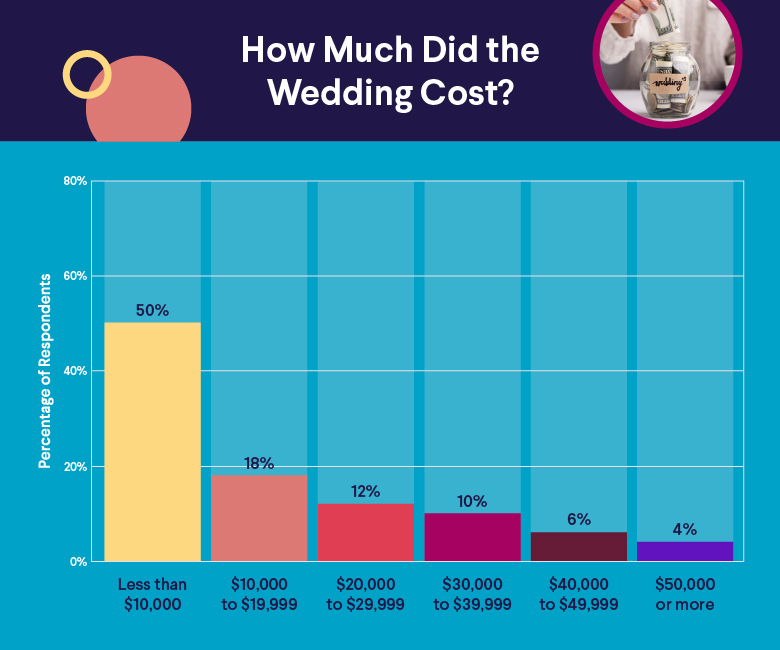
How Much Did the Wedding Cost?

50% of respondents’ weddings cost less than $10,000

Total wedding budget breakdown:

•   Less than $10,000: 50%

•   $10,000 to 19,999: 18%

•   $20,000 to 29,999: 12%

•   $30,000 to $39,999: 10%

•   $40,000 to $49,999: 6%

•   $50,000 or more: 4%

Half of respondents to our wedding survey spent less than $10K on their ceremony and reception. That’s considerably less than the $29K figure that’s been popularized as “average.”

We’re not saying that the $29K budget is inaccurate — after all, half of respondents paid more than that. However, averages in general are notoriously confusing. Only 22% of couples in our survey spent about $29K (between $20K and $39K). And just 10% paid more than that.

But why does this matter?

There’s a concept in behavioral economics called anchoring. It describes how numbers can influence consumer decisions by unconsciously becoming our reference point for what’s standard or “normal.”

Let’s say you’re in the early stages of wedding planning. If you stumble across an authoritative $29K estimate, from then on you may view anything less than that as a “low-budget” wedding. And when figuring out your own wedding budget, you may make decisions that bring you closer to that total — even if a $10K wedding is more aligned with your savings and taste.

Most Common Wedding Regrets

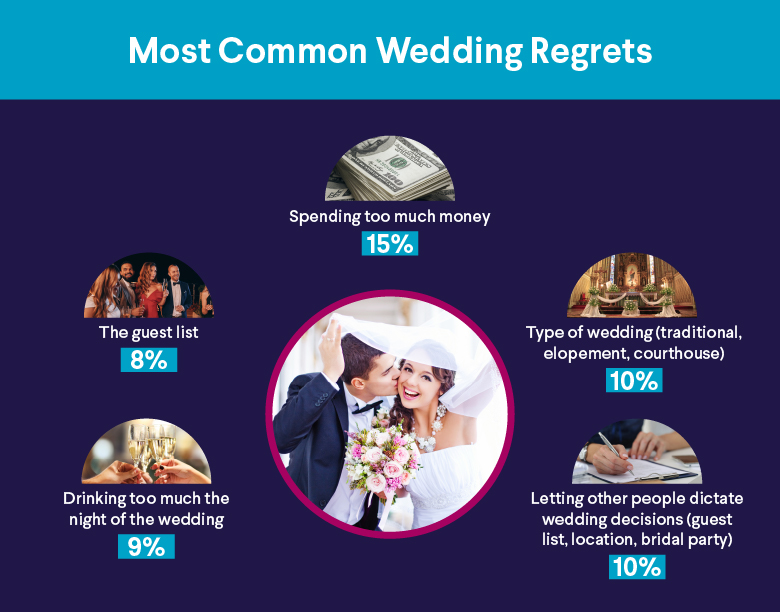
The most common wedding regret? Spending too much money.

15% of respondents said their biggest wedding regret was spending too much money. Other common wedding regrets:

•   Type of wedding (traditional, elopement, courthouse): 10%

•   Letting other people dictate wedding decisions (guest list, location, bridal party): 10%

•   Drinking too much the night of the wedding: 9%

•   The guest list: 8%

You may have heard of a phenomenon called the “vacation mindset,” which drives travelers to splurge on special purchases they wouldn’t consider on their home turf. Well, a similar wedding mindset can push couples to indulge an uncharacteristic desire for luxury. “It’s a once-in-a-lifetime event! Your wedding should be as big as your love for each other!”

After the wedding, as the bills roll in, so does buyer’s remorse. And now, other big-ticket goals that took a backseat to the wedding — buying a home, having kids, expanding a business, or saving for the long term — now feel more urgent.

Nearly half (46%) of respondents who got married in 2020 or later had a nontraditional wedding (they eloped or got married in a courthouse).

Traditional or Not?

•   9% of people eloped. Of those, 6% had a reception with friends and family later.

•   25% of respondents got married in a courthouse. Of those, 18% had a reception with friends and family later.

The pandemic likely drove many couples to forgo big group events in favor of smaller celebrations. But there are other reasons behind the popularity of nontraditional weddings, according to several wedding vendors we spoke to:

3 Reasons to Have a Nontraditional Wedding

Financial goals:
“It’s no surprise that couples might want to scale back their wedding,” says Jim Campbell, founder of Honeymoon Goals. “They don’t want to spend years saving for an elaborate event when they could be saving for other things instead, like traveling together.”

Time:
“The last few years have shown people how much they value their free time,” observes Maddie Ward, of Sonnet Weddings. “Elopements and courthouse weddings are definitely lower-cost, but there’s also much less of a time investment in planning. The prospect of spending a year or more involved in a time-intensive endeavor with your partner has many people looking at alternatives.”

Stress:
“The No. 1 reason to scale back to a micro wedding or elopement is stress!” insists Lee Ramsay, of Lee Ramsay Events. “More guests means more money, and more money means more problems. Save your dollars, and avoid the headache of attempting to make everyone happy.”

The venue (23%) was among the biggest wedding expenses.

Of those who said the venue was the most expensive, the most commonly reported cost was $10,000 (11% of respondents). The most expensive venue cost reported? $500,000.

It’s safe to say that those who spent $10K on their venue had higher overall budgets. Those with smaller wedding budgets often got creative about the venue, choosing a park, beach, or private home or yard.

How Couples Save on Wedding Costs

Other common ways people saved money on their wedding venue were:

•   Limiting the number of guests: 31%

•   Using buffet or family-style food service: 29%

•   Booking a venue that didn’t require additional rentals (chairs, tables, tents): 26%

Nearly two-thirds (62%) of respondents had expenses pop up that they weren’t prepared for.

Sneaky Weddings Costs That Surprise Couples

The most common fee that snuck up on people? Marriage license and officiant fees: 23%.

Other common surprise costs reported by respondents:

•   Taxes and service charges: 17%

•   Pre-wedding events like the rehearsal dinner or welcome party: 15%

•   Meals for vendors: 13%

•   Overtime charges for vendors: 13%

•   Gratuities for vendors: 12%

•   Postage for stationery (invitations, RSVPs, thank you cards): 12%

82% of respondents who had a wedding planner said their planner helped them save money.

“Wedding planning is a lot like cooking. The more you do it, the better you get at it,” explains Jim Campbell. “The more weddings you plan, the better you get at saving money.”

According to The Knot, the average cost of a wedding planner is about $1,900. But a planner’s fee can vary widely widely depending on a number of factors:

•   Location: A destination wedding requires more coordination than a hometown ceremony.

•   Services required: A full-service planner costs more than someone hired to manage certain elements, such as the seating chart or budget.

•   Fee structure: Planners may charge a flat fee, hourly rate, or a percentage of your overall budget.

Only 25% of our respondents hired a wedding planner. (Another 13% said a planner was included with their venue.)

Ryan Mayiras, of Candid Studios wedding photography, thinks many couples don’t need a wedding planner. “Believe it or not, we recommend that most of our customers skip the wedding planner step. Good vendors will go out of their way to help couples plan their wedding,” he says. “We have a collection of timeline templates that we send to our customers for reference. They can skip the planner and go with a day-of coordinator instead. A coordinator is more affordable and will keep the event on schedule, so the couple doesn’t need to worry during the wedding itself.”

Who Paid for the Wedding?

Who paid for the wedding?

39% of respondents said the couple paid for the total cost of the wedding on their own. Of this group:

•   70% said their wedding cost less than $10,000.

•   88% said it cost less than $30,000.

45% of respondents said their parents helped pay for the wedding. 27% said their partner’s parents helped pay.

Aside from the venue, the biggest wedding expenses

Of those who said the food and drinks were the most expensive, the most commonly reported cost was $10,000 (10% of respondents). The next most commonly reported cost for food and drink was $1,000 (8% of respondents).

Those who said the rings were the most expensive reported a wide range of dollars spent. Regardless of the total wedding budget, many couples (35%) splurged on their rings. Here were some of the most commonly reported costs:

•   $300: 5%

•   $500: 7%

•   $1,000: 8%

•   $2,000: 7%

•   $2,500: 5%

•   $3,000: 6%

•   $5,000: 7%

Popular money-saving tactics

The most common ways people saved money on their wedding attire:

•   Shopped around for deals: 33%

•   Bought a dress off the rack: 26%

•   Rented suits: 23%

18% of people said they didn’t try to save money on attire.

The most common ways people saved money on their wedding vendors:

•   Did their own hair and makeup: 38%

•   Hired a friend to do photography/videography: 32%

•   Didn’t provide transportation for wedding party or guests: 30%

The most common ways people saved money on their wedding decor, stationery, and gifts:

•   DIYed decor: 26%

•   Didn’t give gifts to parents: 25%

•   Didn’t give gifts to out of town guests: 24%

Money-Saving Tip

Ashley Meyer of Meyer Photo Video offered other money-saving tips:

•   “Skip traditional paper invitations and stamps, and opt for email invitations.

•   “Save a few hundred dollars by asking a close friend or family member to get ordained online to officiate your wedding.

•   “Join local bridal Facebook groups to buy discounted wedding items from couples who already tied the knot. Couples sell everything from their wedding dress and veil to candles and signage.”

What couples splurged on

The most common splurge was the rings (35%). Other wedding items that respondents splurged on:

•   The food: 32%

•   The dress: 27%

•   The drinks: 23%

•   The venue: 20%

Many wedding planners we spoke with recommended splurging on photos. Yet only 17% of respondents said they splurged on photography/videography.

The real takeaway? Couples don’t have to splurge on anything. You may feel better after your big day if you save your splurging for a new home or fat retirement account.

Financing a Wedding

Should you need a bit of financial assistance to put your wedding savings over the top, a personal loan is a better option than high-interest credit cards. With low rates and no fees required, SoFi can put those final funds at your fingertips the same day as your approval. That way, rather than anticipating how you’ll pay the bills, you can relax and enjoy your wedding.

Learn how SoFi can help you finance your big day.


SoFi Loan Products
SoFi loans are originated by SoFi Bank, N.A., NMLS #696891 (Member FDIC). For additional product-specific legal and licensing information, see SoFi.com/legal. Equal Housing Lender.


Third-Party Brand Mentions: No brands, products, or companies mentioned are affiliated with SoFi, nor do they endorse or sponsor this article. Third-party trademarks referenced herein are property of their respective owners.

Non affiliation: SoFi isn’t affiliated with any of the companies highlighted in this article.

Financial Tips & Strategies: The tips provided on this website are of a general nature and do not take into account your specific objectives, financial situation, and needs. You should always consider their appropriateness given your own circumstances.

SOPL1023028

Read more

Pets and the Holidays: How America Spends

It’s not your imagination: America is pet-crazy. Two out of three households have a pet, and as the holidays roll in, these furbabies are increasingly part of the planning.

Perhaps they occupy the center of the holiday card (wearing a cute Xmas sweater… or an ugly one), travel with their pet parent to Grandma’s house, or receive a pile of presents.

Consider these pet spending statistics: Last year, consumers spent almost $137 billion year-round on their animals, an increase of 11% year over year. Could this spending soar still higher as the winter holidays unfold?

To learn more about this trend, SoFi surveyed 1,200 pet-owning adults from coast to coast in October 2023. Here, you’ll learn more about how animals are making the season more magical and memorable… and how they are being gifted with holiday goodies.

For starters, did you know the following pet spending statistics?

•   70% of people typically buy their pets gifts. Of those, more than a quarter (27%) spend more than $100 on gifts.

•   89% plan to dip into their wallet in some way to maximize their pets’ holiday joy.

Read on to learn the full story on pet owners’ habits and their holiday spending statistics. You may be surprised!

Holiday Joy: Pets Play a Major Role

The holidays are all about togetherness, whether that means watching a game, baking holiday treats, or watching “A Charlie Brown Christmas” on heavy repeat. But SoFi’s survey revealed that people love sharing the season with their pets.

In fact, more than one in four respondents (27%) say they can’t stand the idea of spending the holiday season without their pet by their side. If they can’t take their four-legged friend with them, over the river and through the woods, they might even wish they could just stay home!

So, how do pet owners celebrate the holidays with their pets? Besides getting them gifts, including pets in holiday photos is a popular choice for many (58%), as is putting up decorations, such as stockings, personalized for their pet (47%).

“Why include pets in holiday traditions? It’s simple — these traditions create bonding moments,” says Chris Allen, founder of Oodle Life, a pet blog . “One year, Max actually unwrapped his own gift, a squeaky toy, and the joy on his face was priceless. It not only made our day but also made us feel more connected as a family, furbaby included.”

How Pet Owners Include Their Pets in Their Holiday Celebrations

Here’s are respondents’ favorite ways to include pets in their holiday celebrations:

•   70% get holiday pet gifts.

•   58% include pets in their holiday photos.

•   47% have personalized holiday decor for their pet (such as a stocking or ornament).

•   45% make a special holiday meal for their pet.

•   40% dress up their pets in holiday attire (such as sweaters and hats).

•   40% let their pet be a taste-tester when cooking or baking holiday meals.

•   30% take their pets to holiday events.

•   28% bake holiday treats for their pets.

It just may be that the pet owners who forgo gifts for their critters are taking the extra time to bake holiday biscuits for them.

Including pets can help bond a family. “Our furry friends are integral family members, and holidays just aren’t complete without their spirited participation,” says Dr. Mollie Newton, DVM, founder of pet care resource site, PetMeTwice, “My own whiskered sidekick has his own stocking, which hangs proudly beside the family’s every December.”

Pets Dress the Part for the Holidays

Is there anything cuter than a grumpy cat in a Santa hat? Or a pooch dressed up to look like Max from “How the Grinch Stole Christmas?” Not really! And when pet people party, you can bet most will deck their pet out in special garb: 68% dress up their pet for holiday celebrations.

So let’s take a closer look at exactly how pet people like to deck out their dogs, felines, and other beloved pets for the holidays.

Most Popular Holiday Pet Outfits

Of the pet owners who dress up their pets, here are the most popular ‘fits:

•   71% bought their pet a holiday sweater.

•   61% put a holiday-themed collar/harness on their pet during the holidays.

•   59% made their pet wear a holiday hat (think Santa hats, antlers, and elf ears).

•   47% bought their pet snow and cold-weather gear (such as snow jackets or boots).

•   35% bought themselves and their pet matching pajamas.

“Every Christmas, we put a little reindeer antler headband or Santa hat on our Labradoodle, Max,” says Oodle Life’s Allen, “He struts around, and it’s like he knows he’s the center of attention!”

What better way, after all, to prepare for a pet family’s holiday photo than donning matching hats or pajamas!

Pet Owners Go Big for Holiday Gifts

The vast majority of pet owners will likely go holiday gift shopping for their furry companion, and we wouldn’t be surprised if they wrapped the present and put it under the tree. After all, owners want pets’ holidays to be jolly and joyful, too.

Pet Holiday Wish Lists

About those presents: Many of these aren’t just random impulse purchases. Nearly half of pet owners (46%) say their pet has a holiday wish list. And almost one in five (18%) say their pet’s list is longer than their own!

The SoFi survey revealed that 70% of people typically buy their pets gifts. Wondering how much people spend on their pets? Consider this: Of those who dip into their wallets, more than a quarter (27%) spend more than $100. Talk about pampered pets! This year, 75% of pet owners plan to buy their pets gifts, so the numbers appear to be growing.

Overall, two key factors are likely to impact how much people spend on pets: their earning power and whether or not they have kids.

Household Income Plays a Bigger Role in Pet Gifting

According to SoFi’s research, the more financial means a person has, the more likely they are to go big on gifts for their pets. Perhaps if they are used to buying themselves more luxurious items, they may be more inclined to do the same for their animal. There are designer dog clothes, for instance, costing hundreds of dollars per garment.

Who Spends More Than $100 on Gifts for Their Pets?

In short, as income rises, so too does spending on gifts for our furry friends:

•   42% of respondents with a household income of $100,000 and up spend more than $100 on pet gifts.

•   Only 12% of respondents with a household income under $100,000 spend more than $100 on pet gifts.

39% of Dual-Income Families With Kids Plunk Down $100+ on Pet Presents

Among pet owners, you might think that dual income families who don’t have kids would spend the most, overall, on holiday gifts for their pets. Think again. The SoFi survey uncovered surprising stats on pet gifting:

Dual-income families with kids actually spend more on pet gifts than those families with no kids.

•   39% of dual-income families with kids spend more than $100 on pet gifts.

•   21% of dual-income families with no kids (DINKs) spend more than $100 on pet gifts.

Perhaps seeing how much joy pets bring kids has an impact: It might encourage parents to dip into their wallets more deeply.

Overall, Families With Kids Spend More on Their Pets

Nearly everyone aims to celebrate the holidays affordably, but a much-loved pet may encourage people to spend more freely during the festive season.

More than eight out of 10 (82%) pet owners spend at least $25 more than usual on their pets during the holidays. Some spend still more freely, with 34% of SoFi survey respondents doling out at least $100 more than their norm.

Families With Kids Spend More on Their Pets

Just as kids inspire families to splurge on pet gifts, they also appear to inspire holiday pet spending overall.

Pet owners with kids tend to spend more on their pets during the holidays:

•   46% of dual-income families with kids spend at least $100 more.

•   35% of single-income families with kids spend at least $100 more.

•   30% of dual-income, no kids households (DINKS) spend at least $100 more.

•   23% of single-income, no kids households spend at least $100 more.

While 43% of pet owners say: “My pet is spoiled so I splurge on them during the holidays,” it probably comes as no surprise that those with kids say this most often:

•   78% of families with kids agree with this statement.

•   22% of families with no kids relate to this statement.

Nearly Half Budget Ahead of Time for Holiday Pet Spending

When the holidays approach, many pet parents assess how much they have to spend for the holidays. Whatever type of budget they use, there’s a good chance it includes funds to make the season special for their animals.

Interestingly, nearly half know how much they will spend on their pets for the holidays and sock that money away in advance — that’s good financial planning in action. Here are the details:

•   49% say “Yes, I know how much I’ll spend on my pets and put that money aside for holiday spending.”

•   51% say “No, I don’t plan for how much I’ll spend on my pet during the holidays.”

Note: No word on how much pets are planning to spend on their parents….

Generally, pet parents take a number of different pet-related costs into consideration during the holidays. It’s not just about squeaky toys and catnip, after all. It’s about photos with, say, Molly, the beloved guinea pig, front and center. Yes, nearly half of our respondents budget for holiday photos with their pet. And more than one out of three pet owners account for the cost of getting their pet groomed for the season. Got to look sleek for those pictures, right?

What Holiday Expenses Do Pet Owners Budget For?

Take a closer look at where the dollars go. Aside from holiday gifts, pet owners told SoFi that they plan for the following costs:

•   45% budget for taking holiday photos.

•   38% budget for getting their pet groomed for the holidays.

•   38% budget for seasonal veterinary needs.

•   35% budget for bringing their pets along when they travel for the holidays.

•   33% budget for buying holiday attire for their pet(s).

•   26% budget for boarding or care for pets because they’re booking holiday travel without their animal.

How to Spoil Your Pet… Without the Debt

Just because many SoFi survey respondents may spend lavishly on their pets over the holidays (as many Americans do), that doesn’t mean they abandon their financial savvy and become bad with money. They apply the same money-smart tactics for their pet purchases as they do for their own gear. Coupon clipping? Check. Signing up for emails that might bring rewards? You bet.

How Pet Owners Save on Pet Holiday Spending

Here’s how they make the most of their cash during the holidays:

•   62% say they use coupons to help save money on holiday spending for their pets.

•   48% say they subscribe to pet company marketing emails to scan for deals.

•   40% get money-saving tips from friends and family.

•   24% say they follow influencer recommendations (yes, petfluencers can really have pull).

Recommended: How to Make a Budget: A Beginner’s Guide

Sometimes Naughty, Always Loved

Much as people adore their kitties, rabbits, and dogs, let’s face it: The answer to “Who’s a good boy?” is not always “You are!” Pets can be rascals — chewing shoes, shredding upholstery to ribbons, and leaving muddy pawprints.

Indeed, while many pet parents will be rewarding their good boys (and girls) this season, not all critters may deserve their gifts.

In fact, 22% of pet owners surveyed by SoFi say they’d put their pet on the naughty list.

What Pet Owners Dread the Most During the Holidays

What’s more, the holiday season gives animals ample occasion to run wild. You know the drill: cats deciding to climb the Christmas tree, or a dog dragging lovingly prepared food off the table (Remember how “A Christmas Story” ended?).

Here’s what the SoFi survey respondents had to say on this aspect of the holidays with pets.

What do pet owners dread most during the holidays?

•   37% of respondents say it’s their pet knocking over the Christmas tree or knocking ornaments off the tree.

•   27% say it’s their pet tearing open gifts early.

•   26% say it’s their pet stealing food from the table or counter.

•   24% say it’s their pet misbehaving around family and friends at gatherings.

•   17% say it’s untangling their pet from holiday lights.

Holiday Pet Safety Also a Concern

Amid all the revelry, pet parents are also focused on keeping their animals safe. After all, most people know facts like poinsettia being mildly toxic to dogs. Here’s how SoFi survey respondents feel about protecting their critters, because happy holiday pets are healthy holiday pets.

Almost one in four (23%) worry about needing to use pet-safe holiday decorations. The same percentage fear their pooch might get sick because friends and family overfeed them or slip them slices of forbidden foods just because, hey, it’s the holidays.

Here’s another source of anxiety for pet parents: being separated from their animal companion during the season. Nearly one-third of them worry about having to travel without their pet. They want to make sure wherever they are over the holidays, they have their furbaby right by their side… or in their lap.

“Involving our pets in our holiday celebrations helps us all feel a little more connected during the holiday seasons,” says Devin Stagg, Marketing Manager at dog-training provider, Pupford. “While I think they enjoy the treats and toys, I believe the greatest benefit is to the pup parent!”

Recommended: Tips to Cut Costs When Traveling With Pets

Pets Inspire the Spirit of Giving

If anyone needs further proof that pets are really and truly part of the family, take note. Pets have a way of inspiring gift giving across the generations. Few can resist giving them a little treat, whether that’s a fancy organic dog biscuit or a cat teaser.

61% say their kids give gifts to their pets far the holidays

According to SoFi’s survey, among families with children, 61% say their kids give gifts to the pet. And grandparents love their grand-furbabies, with almost one in three putting a pet present under the tree.

Pets themselves are often a favorite gift, too: 39% of pet owners say they’ve given someone else a pet as a holiday gift. Of those, 36% say they spent more than $100 on the pet, and 5% say they spent more than $1,000.

Takeaway

It’s no secret that Americans love their pets, and so when the holidays roll around, those animals get lavished with love, gifts, and special treatment. SoFi’s survey of 1,200 pet owners in October 2023 uncovered just how much people splurge on their furbabies, what they buy, why, and how pets can leave their imprint (or pawprint) on the holiday season.

When budgeting for the holidays — whether shopping for people, pets, or any other seasonal expense — having the right banking partner can make a difference. A solid financial institution can help give you the tools to make the most of your money.

Interested in opening an online bank account? When you sign up for a SoFi Checking and Savings account with eligible direct deposit, you’ll get a competitive annual percentage yield (APY), pay zero account fees, and enjoy an array of rewards, such as access to the Allpoint Network of 55,000+ fee-free ATMs globally. Qualifying accounts can even access their paycheck up to two days early.


Better banking is here with SoFi, NerdWallet’s 2024 winner for Best Checking Account Overall.* Enjoy 3.60% APY on SoFi Checking and Savings with eligible direct deposit.


SoFi Checking and Savings is offered through SoFi Bank, N.A. Member FDIC. The SoFi® Bank Debit Mastercard® is issued by SoFi Bank, N.A., pursuant to license by Mastercard International Incorporated and can be used everywhere Mastercard is accepted. Mastercard is a registered trademark, and the circles design is a trademark of Mastercard International Incorporated.

Annual percentage yield (APY) is variable and subject to change at any time. Rates are current as of 11/12/25. There is no minimum balance requirement. Fees may reduce earnings. Additional rates and information can be found at https://www.sofi.com/legal/banking-rate-sheet

Eligible Direct Deposit means a recurring deposit of regular income to an account holder’s SoFi Checking or Savings account, including payroll, pension, or government benefit payments (e.g., Social Security), made by the account holder’s employer, payroll or benefits provider or government agency (“Eligible Direct Deposit”) via the Automated Clearing House (“ACH”) Network every 31 calendar days.

Although we do our best to recognize all Eligible Direct Deposits, a small number of employers, payroll providers, benefits providers, or government agencies do not designate payments as direct deposit. To ensure you're earning the APY for account holders with Eligible Direct Deposit, we encourage you to check your APY Details page the day after your Eligible Direct Deposit posts to your SoFi account. If your APY is not showing as the APY for account holders with Eligible Direct Deposit, contact us at 855-456-7634 with the details of your Eligible Direct Deposit. As long as SoFi Bank can validate those details, you will start earning the APY for account holders with Eligible Direct Deposit from the date you contact SoFi for the next 31 calendar days. You will also be eligible for the APY for account holders with Eligible Direct Deposit on future Eligible Direct Deposits, as long as SoFi Bank can validate them.

Deposits that are not from an employer, payroll, or benefits provider or government agency, including but not limited to check deposits, peer-to-peer transfers (e.g., transfers from PayPal, Venmo, Wise, etc.), merchant transactions (e.g., transactions from PayPal, Stripe, Square, etc.), and bank ACH funds transfers and wire transfers from external accounts, or are non-recurring in nature (e.g., IRS tax refunds), do not constitute Eligible Direct Deposit activity. There is no minimum Eligible Direct Deposit amount required to qualify for the stated interest rate. SoFi Bank shall, in its sole discretion, assess each account holder's Eligible Direct Deposit activity to determine the applicability of rates and may request additional documentation for verification of eligibility.

See additional details at https://www.sofi.com/legal/banking-rate-sheet.

Financial Tips & Strategies: The tips provided on this website are of a general nature and do not take into account your specific objectives, financial situation, and needs. You should always consider their appropriateness given your own circumstances.

SOBK1023025

Read more

Finding Value Is in Season: Even the Rich Are Discount Shopping Now

How America shops is shifting in a fundamental way.

Shoppers are turning to discount stores such as Dollar Tree, ALDI, and Big Lots more often, driven largely by spiking inflation, which peaked at 9.1% in June 2022. These days, shoppers are increasingly asking themselves, Why pay more? as they place a higher premium on value.

According to SoFi’s Discount Shopping Survey of 1,500 consumers fielded in August 2023, 81% of respondents are currently shopping at discount stores at least monthly, regardless of their income level.

Surely, the impetus may vary:

•   For many, discount stores are a vital tool when sticking to a tight budget.

•   For others, it might be a way to find splurges, both large and small, at the right price.

Still, though circumstances may vary, a whopping 78% of respondents are laser-focused on snagging the lowest possible prices for items on their list.

While shoppers may have been swayed by ambience and amenities at stores in the past, now it’s all about getting top value for every hard-earned dollar. Sticking to — and stretching — one’s budget is the new black. Also worth noting: Among the ranks of discount shoppers are high-earners pulling in six figures.

SoFi’s proprietary research found intriguing and unexpected facts about just who’s hitting the discount stores, what they are hunting for at these retailers, and why the face of shopping may never be the same again.

Where the Buyers Are: 74% of Respondents Dropped Into Dollar Tree

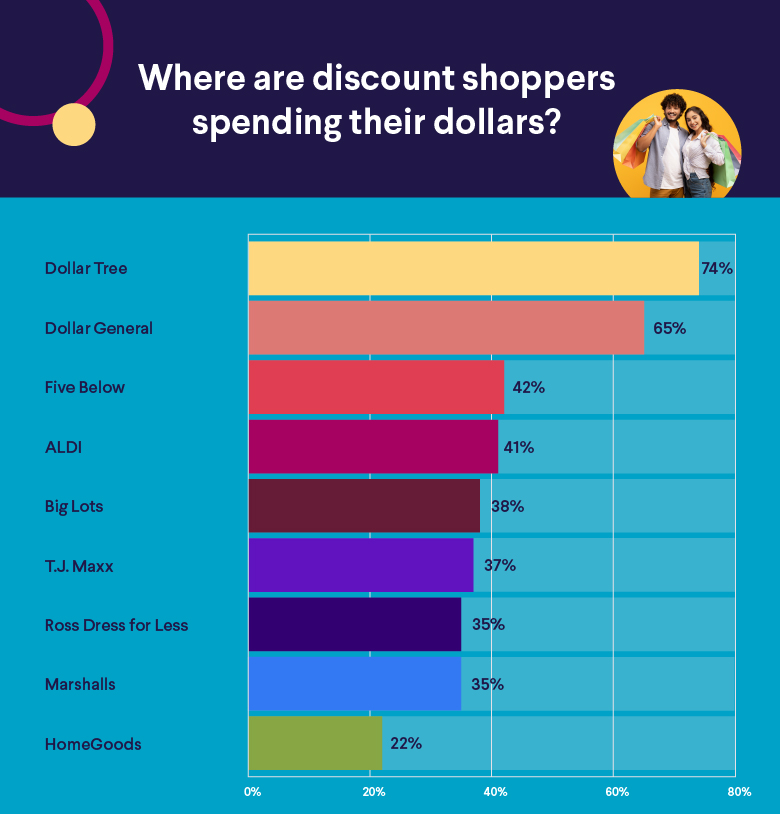
Where are discount shoppers spending their dollars?

Curious about which discount retailers are topping shoppers’ lists? According to SoFi’s Discount Shopping Survey, almost three-quarters (74%) of discount shoppers have dropped into a Dollar Tree, where the motto is “Extreme Value Every Day,” over the past year.

It isn’t just those living paycheck to paycheck who are shopping at Dollar Tree:

•   64% of the survey’s highest earners (households bringing in $150,000+) say they’ve bought items at Dollar Tree in the last 12 months.

Discount shoppers are also looking elsewhere to find where the best buys are. Over the past year:

•   65% have shopped at Dollar General

•   42% at Five Below

•   41% at ALDI

•   38% at Big Lots

•   37% at T.J. Maxx

•   35% at Ross Dress for Less

•   35% at Marshalls

Where else are moneywise shoppers queuing up? It turns out that 22% have shopped at HomeGoods, while one in five (20%) has rung up items at brand-name outlets (Nordstrom Rack, for instance).

Discount Stores: The New Social Media Darlings

Reflecting their new status as many shoppers’ go-to destination, discount stores are accumulating hefty followings. As of September 2023, the stats are:

•   ALDI USA has 955K Instagram followers; 184K on TikTok

•   Dollar Tree has 675K Instagram followers; 76.6K on TikTok

•   Five Below has 706K Instagram followers; 214.3K on TikTok

💡 Quick Tip: Bank fees eat away at your hard-earned money. To protect your cash, open a checking account with no account fees online — and earn up to 0.50% APY, too.

81% Discount-Shop at Least Once a Month

18% of respondents shop at discount stores at least once a month

People aren’t just hitting the discount shops for an occasional find. Rather, SoFi’s discount shopping research uncovered that these retailers are quickly gaining traction as routine destinations for shoppers.

•   81% of respondents shop at discount stores at least once a month.

•   38% — practically four out of ten people — shop at discount stores weekly.

•   14% of respondents say you’ll find them shopping at discount stores several times a week. (These may be people who are saving money daily with their shopping habits.)

Compelling find: Close to half of high-income earners (those making $100,000+ a year) say they shop at discount stores at least weekly.

Inflation Surge Drives Shoppers to Discount Stores

63% of discount shoppers say inflation prompted them to shop at discount stores

If you’re wondering why discount shopping is surging, consider the economic state of our union. After inflation rates fell month after month for a solid year, July 2023 saw an uptick in prices that surely set some people on edge. (Inflation in July 2023 increased 3.2% from July 2022.)

What’s more, the cost of living is soaring. Social Security recipients enjoyed a cost of living adjustment (COLA) to the tune of 8.7% in 2023, one indicator of how steeply the price of, well, everything has been rising.

Indeed, consider this:

•   Nearly two-thirds of discount shoppers (63%) say inflation and rising costs have prompted them to shop at discount stores over the last 12 months.

•   In addition, nearly half of discount shoppers have ramped things up, with 49% saying they are hitting discount stores more frequently than they did before the inflation surge.

When it comes to defending one’s paycheck against price hikes, bargain-hunting is a smart maneuver. ”Inflation is real for just about all of us,” says David Bakke, a consumer finance expert and writer at personal finance blog Dollar Sanity. “My discount shopping has definitely increased. I find myself spending a lot more time at ALDI, Dollar General, and the like.”

Indeed, inflation is making over the way Americans shop. SoFi’s discount shopping data shows this significant stat:

•   40% of respondents say they “always” search for ways to save on their purchases when shopping.

•   Only 2% said they never search for ways to save.

Discount shoppers' cost-cutting tactics

Here are some of the leading tactics discount shoppers have used to cut costs:

•   41% have used couponing websites.

•   40% have subscribed to company emails.

•   31% have followed a company or brand on social media.

•   21% have joined a Facebook group or other online community.

•   18% have followed an influencer on social media who talks about discount shopping.

More Than Half Discount-Shop to Benefit Their Budget

In these challenging economic times, many consumers are embracing budgeting as a way to manage their finances. Almost six out of 10 discount shoppers (58%) say one of the biggest benefits of shopping at discount stores is the ability to stick to a budget.

This holds true for 62% of those with household incomes under $75K, as well as 46% of those pulling in $100K or more.

Other reasons to love these retailers? SoFi’s discount shopper respondents said:

•   Regular availability of discounted products (47%)

•   The convenience and accessibility of discount stores (46%)

•   The ability to find trendy or seasonal items at lower prices (45%)

Another shopping pattern that SoFi’s discount shopping survey uncovered: A significant number of discount shoppers are making most of their purchases from these lower-priced retailers:

•   36% make more than 50% of their purchases at discount stores.

•   Almost one in 10 (9%) of those with household incomes of $150,000 or more do more than 75% of their shopping at discount stores.

First on the Discount Shopping List: Groceries

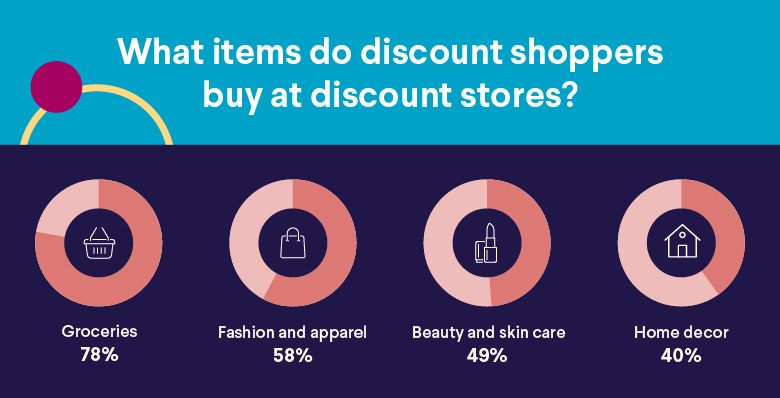
What items do discount shoppers buy at discount stores?

It’s no secret that food prices can trigger sticker-shock, and that’s not just for luxuries like a pumpkin spice latte. Overall, food prices are ratcheting up 5.9% this year, per the USDA’s numbers, which may explain why consumers are hitting the low-cost stores for items they might otherwise buy at a standard supermarket.

According to the SoFi discount shopping research, groceries are the most common purchase made by discount shoppers: 78% buy groceries at discount stores.

And no wonder: These stores often have an array of staples and snacks, from coffee to cookies, and some are putting a health spin on things, as with Dollar General’s “Better for You” selections. Shopping at discount stores can be a solid way to save money on food.

“I shop at discount grocer ALDI,” says Melissa Cid, consumer savings expert with MySavings.com. “Chips, peanuts, cookies, yogurt, and ice cream are 25% to 50% cheaper than at traditional grocery stores.”

After food, the next most popular items:

•   Fashion and apparel: 58%

•   Beauty and skin care: 49%

•   Home decor: 40%

I shop at discount grocer Aldi.

11% Splash Out When Discount Shopping

Think shoppers are only grabbing cereal, socks, and a bottle of shampoo? Not necessarily.

Yes, many people are hunting for lower-priced essentials at the discount stores, but super-low prices are also leading to big-ticket purchases, for some. According to SoFi’s survey:

•   11% of discount shoppers say the most expensive item they’ve purchased at a discount store in the past 12 months cost $250 or more.

Here is what shoppers say are some of the priciest items they purchased at a discount store:

•   18% say it was a fashion/apparel item.

•   16% say it was an electronic item.

•   13% say it was a home decor item.

“Tech gadgets and home essentials top the list of items that I purchase from discount stores,” explains Thomas Paddock, an Amazon FBA Six-Figure Seller and the founder of Learn Retail Arbitrage, an online selling resource. “These categories often carry substantial markups in conventional retail outlets. Discount stores can offer high-quality items at a more
reasonable cost.”

There is, however, a bit of a gender gap when it comes to shopping for certain items at discount stores:

•   36% of men have purchased electronics vs. 27% of women.

•   67% percent of women have made clothing purchases vs. 44% of men.

•   Nearly 3x as many men (22%) have made sports/outdoor purchases vs. women (8%).

Finding Fashion at Discount Shops? Yes, Says Gen Z

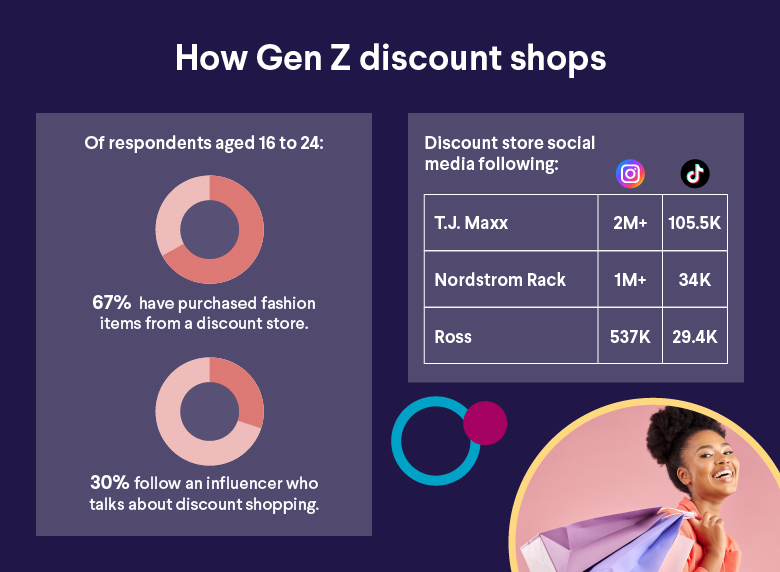
How Gen Z discount shops

The SoFi discount shopping stats reveal that 67% of young people (aged 16-24) have purchased fashion and apparel items at a discount store within the last year.

Given that Gen Z is broadly recognized as the first digitally native generation, it’s probably no surprise that social media may have led many of them to these style purchases:

•   30% of respondents aged 16-24 have followed an influencer on social media who talks about discount shopping, vs. 18% of total respondents.

And the presence these retailers have on social media channels is significant. On Instagram, as of September 2023, T.J. Maxx has 2+ million followers, Nordstrom Rack has 1+ million followers, and Ross Dress for Less has 537K followers. All three have tens of thousands of followers on TikTok.

Almost 50% of Shoppers Seek Seasonal Wares

Seasonal and holiday shopping is (very) big business in the U.S., with Halloween spending, for instance, totalling $10.6 billion in 2022.

“Here today, gone tomorrow” items are part of the allure of discount stores, where goods can be found at a rock-bottom price. Consider these numbers from the SoFi survey:

•   45% of discount shoppers say one of the biggest benefits of discount stores is the availability of lower-priced trendy or seasonal items.

•   65% of discount shoppers are hunting for clearance or end-of-season items.

•   70% of women look for clearance and end-of-season deals at discount stores vs. 56% of men.

More Than Half of Discount Shoppers Spend Serious Time Bargain-Hunting

Discount shoppers spend serious time bargain-hunting

The new wave of smart shoppers are dedicated bargain-hunters. They will invest hours to get a great deal. In fact, more than half (51%) will spend between one and three hours extra to find savings or specific items at discount stores. A dedicated 4% are willing to spend five hours or more. (Of these, 63% have a household income of less than $50,000.)

Discount Shoppers Also Prioritize Availability

60% of discount shoppers with household income of $150,000

Low prices are the leading reason for the popularity of discount shopping, but availability of desired products is another big incentive:

•   52% head to these retailers for the specific items they know they can find there.

Whether it’s a favorite energy bar or shower gel, items that are part of a person’s usual shopping list are a big draw for discount shoppers.

This is especially true of the deep-pocketed respondents to the SoFi survey. Why spend top-dollar on your favorite matcha beverages or other small luxuries when you can buy them for much less?

•   60% of the highest earners (household income of $150,000 or more) say one of the reasons they shop at discount stores is for specific items they know they can find there.

There are a good number of impulse buyers among the aisles though:

•   Almost one in five (19%) discount shoppers say they don’t go to the stores looking for any particular item. Rather, they “go in without a plan and buy things that speak to them.”

As for the rest of the respondents to SoFi’s survey:

•   More than half of discount shoppers (51%) say they know what they need when they go to a discount store, but are open to buying items not on their list.

•   More than a quarter (26%) say they buy what they need and exit ASAP.

•   Only 3% say they just browse and rarely actually purchase anything.

And the Biggest Frustration With Discount Shopping Is…

Obviously, there is much to love about discount shopping, as detailed above. But, yes, there are a couple of pain points. Here, the two biggest downsides:

•   38% of discount shoppers say the items they want aren’t always available. That suggests that consumers would buy even more at these retailers if they could find everything they are hunting for.

•   22% say that the biggest downside is that the items are of a lower quality.

It seems that getting what you want, when you want it, may matter even more than an item’s quality.

That said, Thomas Paddock of Learn Retail Arbitrage contends that you can find good quality if you shop smart. “Contrary to general assumptions, not every item in a discount store is of inferior quality. Many times, these are overstock products or emerging brands,” he says. “Discount stores can be an avenue to discover value.”

The Takeaway

As inflation increases, shoppers of all income levels are finding that discount stores can serve their needs. Of the 1,500 consumers surveyed for SoFi’s Discount Shopping Survey in August 2023, 81% say they are visiting discount stores (think Dollar Tree, ALDI, and Five Below) at least once a month. Popular purchases are food, fashion, personal care, and home decor items.

What frustrates discount shoppers when seeking their budget buys? Lack of availability first and foremost, followed by lower quality of some goods.

For anyone looking to make the most of their money, finding the right banking partner can also make a big difference. One that charges low or no fees and offers a competitive interest rate can help you make the most of your finances.

Interested in opening an online bank account? When you sign up for a SoFi Checking and Savings account with eligible direct deposit, you’ll get a competitive annual percentage yield (APY), pay zero account fees, and enjoy an array of rewards, such as access to the Allpoint Network of 55,000+ fee-free ATMs globally. Qualifying accounts can even access their paycheck up to two days early.


Better banking is here with SoFi, NerdWallet’s 2024 winner for Best Checking Account Overall.* Enjoy 3.60% APY on SoFi Checking and Savings with eligible direct deposit.


SoFi Checking and Savings is offered through SoFi Bank, N.A. Member FDIC. The SoFi® Bank Debit Mastercard® is issued by SoFi Bank, N.A., pursuant to license by Mastercard International Incorporated and can be used everywhere Mastercard is accepted. Mastercard is a registered trademark, and the circles design is a trademark of Mastercard International Incorporated.

Annual percentage yield (APY) is variable and subject to change at any time. Rates are current as of 11/12/25. There is no minimum balance requirement. Fees may reduce earnings. Additional rates and information can be found at https://www.sofi.com/legal/banking-rate-sheet

Eligible Direct Deposit means a recurring deposit of regular income to an account holder’s SoFi Checking or Savings account, including payroll, pension, or government benefit payments (e.g., Social Security), made by the account holder’s employer, payroll or benefits provider or government agency (“Eligible Direct Deposit”) via the Automated Clearing House (“ACH”) Network every 31 calendar days.

Although we do our best to recognize all Eligible Direct Deposits, a small number of employers, payroll providers, benefits providers, or government agencies do not designate payments as direct deposit. To ensure you're earning the APY for account holders with Eligible Direct Deposit, we encourage you to check your APY Details page the day after your Eligible Direct Deposit posts to your SoFi account. If your APY is not showing as the APY for account holders with Eligible Direct Deposit, contact us at 855-456-7634 with the details of your Eligible Direct Deposit. As long as SoFi Bank can validate those details, you will start earning the APY for account holders with Eligible Direct Deposit from the date you contact SoFi for the next 31 calendar days. You will also be eligible for the APY for account holders with Eligible Direct Deposit on future Eligible Direct Deposits, as long as SoFi Bank can validate them.

Deposits that are not from an employer, payroll, or benefits provider or government agency, including but not limited to check deposits, peer-to-peer transfers (e.g., transfers from PayPal, Venmo, Wise, etc.), merchant transactions (e.g., transactions from PayPal, Stripe, Square, etc.), and bank ACH funds transfers and wire transfers from external accounts, or are non-recurring in nature (e.g., IRS tax refunds), do not constitute Eligible Direct Deposit activity. There is no minimum Eligible Direct Deposit amount required to qualify for the stated interest rate. SoFi Bank shall, in its sole discretion, assess each account holder's Eligible Direct Deposit activity to determine the applicability of rates and may request additional documentation for verification of eligibility.

See additional details at https://www.sofi.com/legal/banking-rate-sheet.

Financial Tips & Strategies: The tips provided on this website are of a general nature and do not take into account your specific objectives, financial situation, and needs. You should always consider their appropriateness given your own circumstances.

SOBK1023012

Read more
TLS 1.2 Encrypted
Equal Housing Lender