SoFi Blog

Tips and news—
for your financial moves.

$1K FL offer

{/* OFFER – HERO */}

Home Mortgage Loans

Save more with an exclusive $1,000 bonus on your mortgage.1 Offer ends 12/31/26.

{/* DISCLOSURE CONTENT */}

{/* INSERT DISCLOSURE’S HERE */}

Terms, conditions, and state restrictions apply. Before you apply for a SoFi Mortgage, please note that not all products are offered in all states, and all loans are subject to eligibility restrictions and limitations, including requirements related to loan applicant’s credit, income, property, and loan amount. SoFi Mortgages may be available for primary or second home residences or investment properties. Lowest rates are reserved for the most creditworthy borrowers. Products, rates, benefits, terms, and conditions are subject to change without notice. Learn more at SoFi.com/eligibility. Information current as of 10/31/22.

SoFi Mortgages originated through SoFi Bank, N.A., NMLS #696891 (Member FDIC). Equal Housing Lender. SoFi Bank, N.A. is currently able to issue and refinance mortgages in all states except Hawaii and purchase only for New York.

SoFi requires Private Mortgage Insurance (PMI) for conforming conventional home loans with a loan-to-value (LTV) ratio greater than 80%. Other loan types may require different fees or insurance (e.g., VA funding fee, FHA Mortgage Insurance Premiums, etc.). Loan requirements may vary depending on your down payment amount, and minimum down payment varies by loan type.

✝ To check the rates and terms you may qualify for, SoFi conducts a soft credit pull that will not affect your credit score. However, if you choose a product and continue your application, we will request your full credit report from one or more consumer reporting agencies, which is considered a hard credit pull and may affect your credit.

1 1,000 HL/HE Funded Bonus Offer: This offer is only available for new SoFi home purchase mortgage, SoFi mortgage refinance or SoFi-originated home equity loan. To receive the $1,000 offer you must: (1) Apply for a SoFi home purchase, SoFi mortgage refinance or SoFi-originated home equity loan through the promotional ‘View Your Rate’ link in this ad. (2) You must not have locked a rate for a SoFi home purchase mortgage, mortgage refinance or SoFi-originated home equity loan within the preceding 90 days. (2) Fulfill SoFi’s eligibility criteria and lock your rate. (3) Fund your SoFi home purchase mortgage, SoFi mortgage refinance or SoFi-originated home equity loan by 12/31/25. (4) Either have an existing SoFi Checking and Savings account or establish a new SoFi Checking and Savings account within 60 days after starting your home equity loan application.

This offer cannot be combined with other offers, with the exception of the standard Member discount and the SoFi Plus Member discount. To be eligible for the SoFi Plus member discount, the member must receive a Direct Deposit into their SoFi Checking/Savings account or pay the SoFi Plus Subscription Fee, at or before the time their home loan application is approved (indicated as “final approval”). Direct Deposit means a recurring deposit of regular income to an account holder’s SoFi Checking or Savings account, including payroll, pension, or government benefit payments (e.g., Social Security), made by the account holder’s employer, payroll or benefits provider or government agency (“Direct Deposit”) via the Automated Clearing House (“ACH”) Network during a 30-day Evaluation Period (as defined below). Deposits that are not from an employer or government agency, including but not limited to check deposits, peer-to-peer transfers (e.g., transfers from PayPal, Venmo, etc.), merchant transactions (e.g., transactions from PayPal, Stripe, Square, etc.), and bank ACH funds transfers and wire transfers from external accounts, or are non-recurring in nature (e.g., IRS tax refunds), do not constitute Direct Deposit activity. There is no minimum Direct Deposit amount required to qualify for the stated interest rate.

Once conditions are met, your $1,000 bonus will be deposited into your SoFi Checking and Savings account within approximately 30 calendar days after your SoFi home purchase mortgage, SoFi mortgage refinance or SoFi-originated home equity loan funds. Bonus amounts of $600 or greater in a single calendar year will be reported to the Internal Revenue Service (IRS) as miscellaneous income to the recipient on Form 1099-MISC in the year received as required by applicable law. Recipient is responsible for any applicable federal, state, or local taxes associated with receiving the bonus offer; consult your tax advisor to determine applicable tax consequences. SoFi reserves the right to change or terminate the offer at any time with or without notice to you. Additional terms may apply.

2 Lock and Look Program: Terms and conditions apply. Applies to conventional purchase loans only. Rate will lock for 90 calendar days at the time of pre-approval subject to payment on 60th day of the fee below. If you submit a fully executed purchase contract within 30 days of the initial rate lock, SoFi will reduce the interest rate by an additional 0.125% at no cost. If current market pricing has improved by .75 percentage points or more from the original locked rate, you may qualify for an additional rate reduction. If you have not submitted a fully executed purchase contract within 60 days of your initial rate lock, you will be charged $250 to maintain the rate lock through the 90-day period. The $250 fee will be credited back to you at the time of closing. SoFi reserves the right to change or terminate this offer at any time with or without notice to you.

3 Obtain a SoFi mortgage for the purchase of a home and SoFi will waive its administrative fee when you refinance. Eligibility conditions: (1) You must close your new purchase mortgage by June 30, 2023; (2) at the time of refinancing, the current market interest rate must be at least 1% less than the interest rate of the original loan; and (3) To redeem this offer, you must request waiver of the administrative fee at the time you apply for the refinancing loan and prior to locking your rate. This offer is limited to one (1) refinance transaction per person. Refinance transaction must occur by June 1, 2024. SoFi reserves the right to change or end this offer at any time.

‡ SoFi On-Time Close Guarantee: If all conditions of the Guarantee are met, and your loan does not close on or before the closing date on your purchase contract accepted by SoFi, and the delay is due to SoFi, SoFi will provide you $2,000.^ Terms and conditions apply. This Guarantee is available only for loan applications submitted after 6/15/22 for the purchase of a primary residence. Please discuss terms of this Guarantee with your loan officer. The property must be owner-occupied, single-family residence (no condos), and the loan amount must meet the Fannie Mae conventional guidelines. No bank-owned or short-sale transactions. To qualify for the Guarantee, you must: (1) Have employment income supported by W-2, (2) Receive written approval by SoFi for the loan and you lock the rate, (3) submit an executed purchase contract on an eligible property at least 30 days prior to the closing date in the purchase contract, (4) provide to SoFi (by upload) all required documentation within 24 hours of SoFi requesting your documentation and upload any follow-up required documents within 36 hours of the request, and (5) pay for and schedule an appraisal within 48 hours of the appraiser first contacting you by phone or email. The Guarantee will be void and not paid if any delays to closing are due to factors outside of SoFi control, including delays scheduling or completing the appraisal appointment, appraised value disputes, completing a property inspection, making repairs to the property by any party, addressing possible title defects, natural disasters, further negotiation of or changes to the purchase contract, changes to the loan terms, or changes in borrower’s eligibility for the loan (e.g., changes in credit profile or employment), or if property purchase does not occur. SoFi may change or terminate this offer at any time without notice to you. ^To redeem the Guarantee if conditions met, see documentation provided by loan officer.

* Terms and conditions apply. The discount is only available for SoFi purchase mortgage transactions only. The discount will be reflected in the rate you are provided at the time of rate lock. This discount cannot be combined with other offers, with the exception of the standard $500 Member discount and the $1000 SoFi Plus Member discount. SoFi reserves the right to change or terminate this offer at any time with or without notice to you

All information in the primary residence payment examples listed above — including interest rates, payments, terms, and availability — is for informational purposes only and is subject to change without notice.

The trademarks, logos and names of other companies, products and services are the property of their respective owners.

CNBC Select makes its selection, which you can see here, based on their own methodology.

See privacy policy.

{/* CTA Mobile */}


View your rate

Checking won’t affect your credit score.

{/* CTA Desktop*/}


View your rate

Checking won’t affect your credit score.

Read more

Which Money Transfer Option Should You Use?


Help Center > Banking FAQ > Transfer FAQ > Which Money Transfer Option Should You Use?

Which Money Transfer Option Should You Use?

Last updated November 27, 2024. For the latest limits, please visit the SoFi app.

Situations:

    Sending money should be easy, but with so many options out there, figuring out the best way can be confusing. Whether you’re buying a home, paying rent, or just sending cash to a friend, different situations call for different solutions. That’s where SoFi comes in. This guide breaks down the top transfer methods available through SoFi Checking & Savings for each situation, helping you find the safest, most affordable way to move your money – no matter the reason. Let’s dive in and make those transfers a breeze!

    To make it even easier, here’s a quick summary of the best methods for each scenario:

    Situation Recommended Method
    Sending Money to Friends & Family on SoFi Pay-a-Friend (P2P)
    Sending Money to Friends & Family Outside SoFi Zelle®
    Paying Bills and Rent Bill Pay
    Transferring Between Banks Transfer (ACH)
    Recurring Transfers Transfer (ACH)
    Buying a Home Wire Transfer
    Buying a Car Wire Transfer

    7 Common Scenarios for Sending Money Online

    1. Sending Money to Friends & Family on SoFi

    Recommended Method: Pay-a-Friend (P2P)

    Fees: None1

    Timing: Instant

    Limits: Up to $5,000 per day

    Step-by-Step Directions: How to Use SoFi’s Pay-a-Friend

    If your recipient is a SoFi Checking & Savings member, our internal Pay-a-Friend (P2P) transfer option is instant and secure.

    2. Sending Money to Friends & Family Outside SoFi

    Recommended Method: Zelle®

    Fees: Fee-free when you use our app or online banking platform1

    Timing: Within minutes2

    Limits: $1000 per day

    Step-by-Step Directions: How to Send Money Using Zelle

    Zelle® is a fee-free option that allows you to send money directly to your recipient within minutes, even if they are not a SoFi member, as long as they are enrolled with Zelle®. You can initiate these transfers within the security of our mobile app or online banking platform.

    3. Paying Bills and Rent

    Recommended Method: Bill Pay

    Fees: None1

    Timing: 1-5 business days

    Limits: Up to $25,000 per transaction

    Step-by-Step Directions: How to Use SoFi’s Bill Pay

    Staying on top of monthly bills is essential, and we make it a breeze with our online bill pay feature. You can schedule one-time or recurring payments to ensure your rent, utilities, credit cards, and other bills are paid on time, without any hassle. We use ACH (Automated Clearing House) transfers whenever possible, so your payments are processed quickly and are easy to track.

    For certain payments, like rent, where you only have your landlord’s physical address and not their bank account information, we will send a check by mail on your behalf. This ensures all your bills are covered and saves you time and effort.

    Whether it’s a company or an individual, our reliable bill pay option has you covered. Managing your bills has never been easier.

    4. Transferring Money Between SoFi Checking & Savings and an External Bank

    Recommended Method: Transfer (ACH)

    Fees: None1

    Timing: 1-3 business days

    Limits:

    Incoming Transfers – If transferring from another bank account to your SoFi Checking & Savings account:
    $100,000 per day | $200,000 per month

    Outgoing Transfers – If transferring from your SoFi Checking & Savings account to another bank account:
    $1,000,000 per day | $2,000,000 per month

    Step-by-Step Directions: How to Transfer Money Between SoFi and Another Bank

    Transferring money between banks is simple and secure with our bank-to-bank transfer option. Using ACH transfers, you can move funds between your accounts at different banks without any fees, making it easy to manage money across multiple accounts. Transfers typically take 1–3 business days to complete, but we work to ensure your funds are on the way quickly. Whether you’re saving, investing, or just moving funds, our bank-to-bank transfers make it convenient to manage your finances.

    5. Recurring Transfers

    Recommended Method: Transfer (ACH)

    Fees: None1

    Timing: Instant on the scheduled date

    Limits: $100,000 per day | $200,000 per month

    Step-by-Step Directions: How to Setup Recurring Transfers with SoFi Checking and Savings

    Recurring transfers make it easy to automate your finances and stay on top of your goals. With our recurring transfer options, you can set up automatic transfers between your SoFi Checking and Savings accounts or even to accounts at other banks. Whether you’re building your savings or sending monthly support to family, setting up a recurring transfer keeps you on track without having to remember to send or move money. It’s a hands-free way to stay organized and keep your financial goals moving forward.

    6. Buying a Home

    Recommended Method: Wire Transfer

    Fees: $301

    Timing: Same-day processing

    Limits: None

    Step-by-Step Directions: How to Setup Wire Transfer with SoFi Checking and Savings

    Buying a home is one of the biggest financial steps you’ll take, and we’re here to make the payment process as smooth as possible. For large transfers like a down payment, wire transfers are typically the safest and fastest option, allowing funds to move securely between banks on the same day. We also provide guidance and support through each step, so you can feel confident your funds are reaching the right place on time. With our secure transfer options, you’re one step closer to making your dream home a reality.

    7. Buying a Car

    Recommended Method: Wire Transfer

    Fees: $301

    Timing: Same-day processing

    Limits: None

    Step-by-Step Directions: How to Setup Wire Transfer with SoFi Checking and Savings

    Buying a car often involves transferring a significant amount of money, and Wire Transfer makes it easy and secure. With same-day processing, you can be confident that the funds will arrive securely and promptly, making the car-buying process smoother.

    For more questions and answers related to online transfers with SoFi, visit our Help Center.


    Visit Help Center

    Read more

    Guilt-Free Tweaks to Trim Your Holiday Budget

    This article appeared in SoFi's On the Money newsletter. Not getting it? Sign up here.

    How do you do the holidays justice when money is tight?

    You want to make the holiday season special for your family and friends, and you may feel you need to outdo last year — or at least keep up with everyone else.

    Two-thirds of shoppers in a Beyond Finance survey said they feel an unhealthy cultural pressure to buy holiday gifts when they can’t afford them. And 19% admitted they’d bought gifts or trips so they could post about them on social media.

    In other words, guilt, FOMO, and Instagram can make it hard not to overspend, even when prices are high and the economy feels increasingly precarious. And yet a monthly Gallup poll showed Americans downsized their holiday gift budgets more than they ever have in the middle of the shopping season: By November they were expecting to spend $778, on average, down from $1,007 in October.

    So what can you do to stay true to your budget without going full Grinch? Here are some ground rules that could help:

    •  Have a holiday heart-to-heart. If you’re facing a cash crunch this season, chances are that some of the people you exchange gifts with are, too. They’ll be relieved when they see your simple group text request: “Santa’s pursestrings are a little tighter this year, so why don’t we try something a little different?”

      Be ready with suggestions like a white elephant exchange in which everyone has to buy (and receive) one meaningful price-capped gift rather than presents for everyone. Or set a spending limit for everyone at your celebration to help reduce anxiety and decision fatigue. You could also make it a kids-only gift year.

    •  Cap it at four gifts. If you have kids and the Santa haul in your house has gotten out of control, adopt the viral “four gift rule.” The idea is simple: Each child gets something they want, something they need, something to wear, and something to read. (You may need it for the adults in your life, too.)

    •  Set an example. Speaking of kids, it’s easy to think we’re not doing enough for them, and it’s natural to want to take them to a magical theater performance or decorate the house and yard to the nines. But what better way to model living within your means than making your reality a teachable moment.

    “Let them know when they’re an adult, some years are going to be better than others,” Mary Clements Evans, a certified financial planner, told Scary Mommy. “Some years, you’re going to have more money than others. If they’re old enough, try to teach them a little bit about inflation. What happens if somebody loses a job? I don’t think you can teach kids those lessons too young.”

    •  Scale the love. If you have a bunch of relatives or one big friend group on your gift list, consider putting effort into one gift that will make everyone smile — like a digital family greeting, photo collage, or special bread. (According to a recent Deloitte survey, Gen Zs and Millennials are the most likely to make their own gifts this season, including food gifts like baked goods, sauces, and charcuterie.)

    •  Let tradition trump tickets. Stage shows and fancy New Year’s Eve dinners can get pricey fast. But there are other fun traditions that cost far less (or nothing), and they may end up being more memorable for you and your loved ones. Pile the family in the car with some to-go hot chocolate and look for the coolest light displays. Take everyone ice skating or sledding. Or have a holiday-themed potluck party with karaoke.

    •  Stock emergency gifts to avoid last-minute expenses. When you need gifts right away, you’re at the mercy of expedited shipping costs or the prices at the only place that’s still open. If you spot a good go-to gift, grab an extra (or two) so you’ll always have something on hand for that person you accidentally left off your list.

    •  Catch yourself. How did matching family pajamas, elaborate advent calendars, “brrr baskets,” and stocking stuffers pricey enough to be the actual gift infiltrate our holiday gift list? If you’re committed to scaling back, these extras could be a good place to start.

    •  Ditch the guilt. You don’t have to spend what you spent in the past. If you can get by with $15 gifts for your nieces and nephews, don’t go grabbing something for an additional $10 to make up the difference. This year, take the win.

    Related Reading

    Learn to Recognize Holiday Spending Triggers (Take Charge America)

    30 Amazing Gift Ideas That Cost Next to Nothing (Real Simple)

    Are the Discounts Worth Getting That Store Credit Card? (SoFi)


    Please understand that this information provided is general in nature and shouldn’t be construed as a recommendation or solicitation of any products offered by SoFi’s affiliates and subsidiaries. In addition, this information is by no means meant to provide investment or financial advice, nor is it intended to serve as the basis for any investment decision or recommendation to buy or sell any asset. Keep in mind that investing involves risk, and past performance of an asset never guarantees future results or returns. It’s important for investors to consider their specific financial needs, goals, and risk profile before making an investment decision.

    The information and analysis provided through hyperlinks to third party websites, while believed to be accurate, cannot be guaranteed by SoFi. These links are provided for informational purposes and should not be viewed as an endorsement. No brands or products mentioned are affiliated with SoFi, nor do they endorse or sponsor this content.

    SoFi isn't recommending and is not affiliated with the brands or companies displayed. Brands displayed neither endorse or sponsor this article. Third party trademarks and service marks referenced are property of their respective owners.

    OTM20251215SW

    Read more

    5 Ways to Milk Your Year-End Bonus

    This article appeared in SoFi's On the Money newsletter. Not getting it? Sign up here.

    Getting a bonus can feel like winning a small lottery. But if you’re tempted to splurge with it, don’t forget to consider your financial future, too. Maybe use 10% or 20% to treat yourself, and put the rest toward something that will have a lasting impact.

    Need guidance? Here are five ways to make your bonus really matter.

    1. Pay down credit cards. If you’re carrying a credit card balance, paying it off (or at least down) is arguably the best use of your bonus. Credit cards have some of the highest interest rates of any loan — especially in today’s economy — charging over 22%, on average. And the interest compounds daily, costing you more with each passing day.

    For example, depending on how slowly you pay it off, a $5,000 credit card balance with a 22% APR could wind up costing you more than $5,000 just in interest. (It would cost $1,750 in interest if you’re paying $200 a month, $8,678 if you’re paying $100 a month.)

    Why not use your bonus to break free of this burden and free up more of your hard-earned cash in the future? (This SoFi calculator can do the math for you.)

    2. Supercharge your retirement savings or Health Savings Account (HSA). Even if you’re already contributing regularly to your 401(k) or IRA, adding a lump sum can leave you with a substantially larger nest egg when you retire, thanks to the power of compound growth.

    Or, if you have one, add your bonus to your HSA, which could become even more valuable as healthcare costs rise. HSA funds not only never expire, but they can be invested and even become a stealth retirement savings vehicle.

    Plus, maxing out these types of tax-advantaged accounts lowers your taxable income for the year.

    Bonus tip: If you’ve already maxed out your 401(k) and don’t have a high-deductible plan, consider funding a Roth IRA with after-tax money. There’s no immediate tax benefit, but your investment earnings and all qualified withdrawals will be tax-free once you’re retired, when you could be in a higher tax bracket.

    3. Build up your emergency savings. If you haven’t bulked up your savings, adding your bonus can give you peace of mind. Maybe you’re not sure if you’ll have enough to bridge the gap if you’re laid off, your car breaks down, or there’s a medical emergency.

    Whatever happens, having enough in your emergency fund can help you avoid accruing debt (and unnecessary stress) to cover unexpected expenses. (Ideally, you’ll have enough saved to cover three to six months’ worth of living expenses.)

    Pro tip: Use a high-yield savings account to earn interest while keeping your money accessible.

    4. Save for other stuff. Beyond emergencies and retirement, your bonus can jumpstart savings for specific goals like home renovations or a special vacation. Or, wouldn’t it be nice to have money set aside for something unexpectedly good instead of bad? Consider starting an “opportunity fund.” Maybe you discover your new side hustle is going well enough to require more equipment or a website upgrade. Or you get a new job on the other side of the country and need money for your move.

    Whatever you’re saving for, keeping the funds separated or in a dedicated account will make them less tempting to dip into. (We like the Vaults feature of SoFi high-yield accounts.)

    5. Prepay to get the discount. There are many expenses that can cost less if you prepay — or pay for the entire year rather than month-by-month. These include:

    •   Insurance premiums (auto, home, life)

    •   Property (HOA fees, property taxes)

    •   Education (tuition, daycare, music lessons)

    •   Memberships (gym, Amazon Prime, streaming services)

    •   Utilities (internet, security monitoring)

    •   Healthcare (dental work, LASIK)

    •   Professional (software subscriptions, licenses)

    If the discount is sizable, consider paying ahead to get the best bang for your buck. (Just make sure these costs will continue to be part of your life — or that they’re refundable if things change.)


    Please understand that this information provided is general in nature and shouldn’t be construed as a recommendation or solicitation of any products offered by SoFi’s affiliates and subsidiaries. In addition, this information is by no means meant to provide investment or financial advice, nor is it intended to serve as the basis for any investment decision or recommendation to buy or sell any asset. Keep in mind that investing involves risk, and past performance of an asset never guarantees future results or returns. It’s important for investors to consider their specific financial needs, goals, and risk profile before making an investment decision.

    The information and analysis provided through hyperlinks to third party websites, while believed to be accurate, cannot be guaranteed by SoFi. These links are provided for informational purposes and should not be viewed as an endorsement. No brands or products mentioned are affiliated with SoFi, nor do they endorse or sponsor this content.

    SoFi isn't recommending and is not affiliated with the brands or companies displayed. Brands displayed neither endorse or sponsor this article. Third party trademarks and service marks referenced are property of their respective owners.

    OTM2025121501

    Read more

    Week Ahead on Wall Street: Don’t Hibernate Just Yet

    In a typical year, the week following the final Federal Reserve meeting of the year would mark the beginning of the holiday drift. Trading volumes would start drying up, news flow would slow to a trickle, and investors would essentially pack it in for the year.

    This week, like so much of 2025, won’t be typical, though. Investors are still playing a game of catch-up with economic data, and the government will release jobs numbers and key inflation metrics for November.

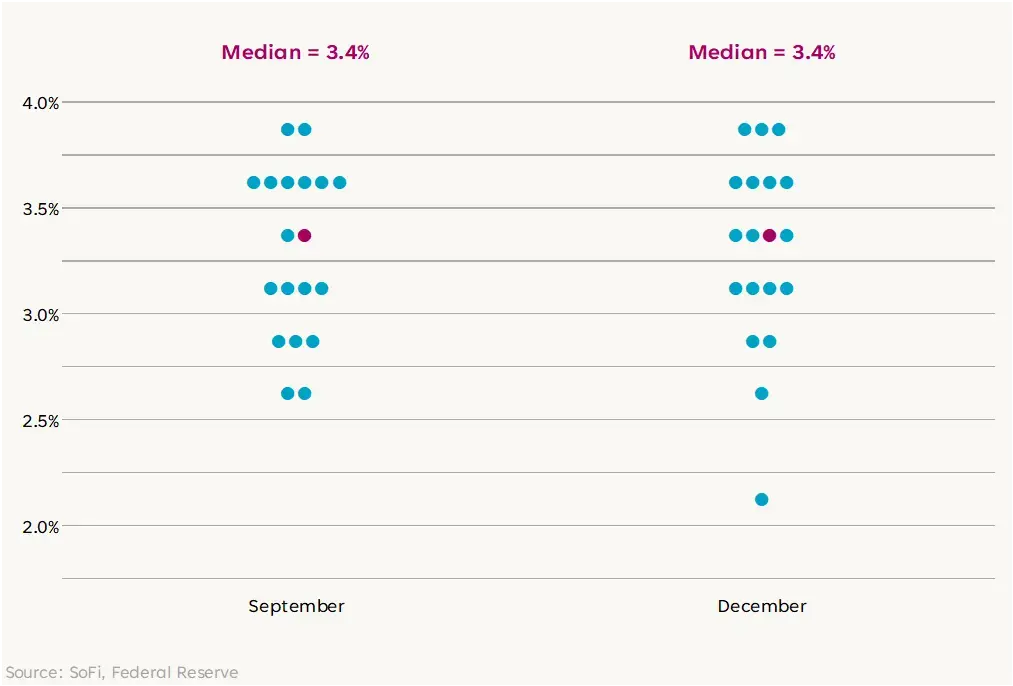
    Plus, now that the Fed meeting is behind us, the communications blackout period is over and Fed officials are free to publicly speak about monetary policy and their economic outlooks. We expect a meaningful amount of discussion given the range of views underlying the Fed’s latest decision to lower its benchmark interest rate. (It was a 9-3 vote, and committee members disagreed about where rates could go in 2026).


    Dot Plot for 2026 Reveals Deepening Disagreement On Rates


    The temptation might be to tune out and look toward the holidays, but the market has a few more hurdles to clear. Between the flood of delayed data and the slate of speeches from Fed officials, this week promises to be an eventful one.

    Economic and Earnings Calendar

    Monday

    •  December Empire State Manufacturing Activity: The New York Fed’s survey of manufacturing executives in the region on business conditions and their outlook.

    •  December NAHB Housing Market Index: This index tracks how homebuilders feel about the current and future state of the single-family housing market.

    •  Fedspeak: Fed Governor Stephen Miran will participate in a moderated conversation with former Fed Vice Chair Richard Clarida at Columbia University’s Institute of Global Politics. New York Fed President John Williams will deliver keynote remarks at a New Jersey Bankers Association event.

    Tuesday

    •  November Employment Situation Summary: This monthly blockbuster release from the Labor Department gives a comprehensive look at employment, wages, and hours worked in the previous month.

    •  October Retail Sales: This measures spending at retail stores and is a key indicator of consumer demand.

    •  December New York Services Activity: The New York Fed’s survey of manufacturing executives in the region on business conditions and their outlook.

    •  December S&P Global US PMIs: These indexes track how purchasing managers across different industries feel about the business environment.

    •  Earnings: Lennar (LEN)

    Wednesday

    •  Weekly Mortgage Applications: Mortgage activity gives insight on demand conditions in the housing market.

    •  Fedspeak: Williams will deliver opening remarks at the regional Fed’s FX Market Structure conference. Atlanta Fed President Raphael Bostic will participate in a moderated discussion at the Gwinnett County Chamber of Commerce.

    •  Earnings: General Mills (GIS), Jabil (JBL), Micron Technology (MU)

    Thursday

    •  November Consumer Price Index: The CPI is one of the most popular indicators for tracking consumer price trends and is a marquee release for market watchers.

    •  December Philadelphia Fed Manufacturing Activity: The Philadelphia Fed’s survey of manufacturing executives in the region on business conditions and their outlook.

    •  December Kansas City Fed Manufacturing Activity: The Kansas City Fed’s survey of manufacturing executives in the region on business conditions and their outlook.

    Friday

    •  November Existing Home Sales: Most home transactions in any given month tend to come from the existing market, and as a result set the tone for the broader housing market.

    •  December University of Michigan Consumer Sentiment: How consumers feel about economic conditions affect their spending habits. This survey places a particular focus on inflation and its trajectory.

    •  December Kansas City Fed Non-Manufacturing Activity: The Kansas City Fed’s survey of services executives in the region on business conditions and their outlook.

    •  Earnings: Conagra Brands (CAG), Lamb Weston (LW), Paychex (PAYX)


    Want to see more stories like this?
    On the Money is SoFi’s flagship newsletter
    for all things personal finance.

    Check it out


    Please understand that this information provided is general in nature and shouldn’t be construed as a recommendation or solicitation of any products offered by SoFi’s affiliates and subsidiaries. In addition, this information is by no means meant to provide investment or financial advice, nor is it intended to serve as the basis for any investment decision or recommendation to buy or sell any asset. Keep in mind that investing involves risk, and past performance of an asset never guarantees future results or returns. It’s important for investors to consider their specific financial needs, goals, and risk profile before making an investment decision.

    The information and analysis provided through hyperlinks to third party websites, while believed to be accurate, cannot be guaranteed by SoFi. These links are provided for informational purposes and should not be viewed as an endorsement. No brands or products mentioned are affiliated with SoFi, nor do they endorse or sponsor this content.

    SoFi isn't recommending and is not affiliated with the brands or companies displayed. Brands displayed neither endorse or sponsor this article. Third party trademarks and service marks referenced are property of their respective owners.

    Read more
    TLS 1.2 Encrypted
    Equal Housing Lender